Reflections on our Year 2020 with the Living Refugee Archive
Written by Paul Dudman, Archivist at UEL and Web Editor at the Living Refugee Archive.
 I’m not sure what else can be said about the year 2020, that has not already been said countless times across traditional media, social media, in communities, both local and transnational, and between families and friends across the world – about the impact of this terrible coronavirus and the impact that it has had across communities, not least amongst the most vulnerable in our societies. We can only help that the various vaccines that have been developed across the world prove to be as effective as has been suggested and that they are rolled out speedily and efficiently to everyone that needs them. The Covid-19 pandemic and the impact of the Black Lives Matter movement following the tragic death of George Floyd have highlighted the importance of social justice to our societies and we must continue to look at ways in which we can respond and support social justice issues across all of our communities, and how should continue to reflect on our own roles and responsibilities in helping to support and encourage collaborative approaches to equality and diversity issues.
Issues of social justice, equality, and diversity have long been issues we have worked with here at the University of East London Archives, initially with the arrival of the Refugee Council Archive back in November 2002, which has led to almost two decades of work looking at developing codes of best practice in terms of how we document, preserve and make accessible archival collections documenting refugee history, whilst looking at ethical ways of developing oral history methodologies for supporting the collection of testimonies of displacement and how this should be undertaken, archives and the responsibilities of representing these narratives to a wider audience. 2021 makes the 70th anniversary of the Refugee Council, founded in 1971 as two separate organisations – the British Council for Aid to Refugees (BCAR) and the Standing Committee on Refugees (SCOR). Much of our work in 2021 will therefore be focused on exploring how we can represent and showcase this 70 year period of voluntary sector engagement with refugees and how we can ensure we document this for posterity.
But before delving too far into our plans for 2021, it is perhaps useful to reflect on our work over the year 2020, and the challenges and opportunities this would present to us. Little did we realise when we started the year that it would be so rapidly curtailed by early March 2020, when the decision was taken for the UK to go into full lockdown, resulting in a move to online working and the temporary closure of our physical archive spaces. Ten months on, we are still working from home and this has obviously had a significant impact on the work we have been able to do with our physical archive collections, which have unfortunately had to remain closed throughout this ten-month period to the time of writing. Just were going into full closure mode, we did received the positive news that our collaboration with the Association of Ukrainian Women to help preserve their important archival collection had been approved for Heritage Lottery Funding, to support the preservation, outreach, and engagement work. We hope once we get back to some semblance of normal service again we can fully realise this collaborative project and support the accession of their invaluable archive to UEL.
Whilst our work with our physical collections has been curtailed, this did enable us some time and opportunity to work with and further develop the Living Refugee Archive online portal. Throughout the lockdown period we have been fortunate to be able to work on several virtual presentations in which we have been able to showcase different aspects of the refugee and migration archival collections that we hold.
2020 has proved to have been the most successful year to date for the Living Refugee Archive as an  online portal back in 2015. In the calendar year 2020, we received a total of 10,042 page hits. This has been the first time we have broken the 10 thousand barrier and also more than doubles our previous best for annual page hits, 4,555 back in 2016. This I hope is a reflection of the collaborations and engagement we have been able to achieve, especially of the course of lockdown which has enabled us to bring together a range of open-access digital archives; academic collaborations; virtual exhibitions, and guest posts on our blog. This began when I was asked to be a part of the panel for the History Acts 22 virtual workshop on `Recording a Crisis’ (link to the virtual recording: http://www.historyacts.org/22-recording-a-crisis/) which explored how we as archivists can, and should respond, to crises like the current pandemic, and the impact that such crises can have on effectively silencing certain parts of our communities.
It was fortunate serendipity that a colleague who was present for this virtual workshop contacted me later about presenting to postgraduate graphic design students at the Royal College of Arts as part of a project that they were co-leading on and this presented an opportunity to bring our archives to a new audience and to consider how archives and the testimonies they contain can facilitate and enable visual responses and highlights the potential for examining the stories and narratives that we hold in the Archive in new and interesting ways. We very much that this collaboration can continue and develop and we hope to also collaborate further with graphic design colleagues based at UEL. This also resulted in a presentation to UEL Arts and Digital Industries Staff and Students on the Archive as part of their Cultural Manoeuvres series of talks. It was also very interesting to connect with archival and history students at the Central European University (CEU) in Vienna for two virtual presentations on the Refugee Archives and our Tate Lives civic engagement project in North Woolwich and Silvertown.
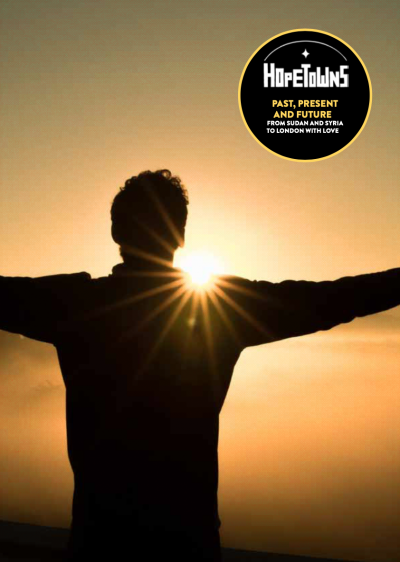 Our new Open Access Digital Archives uploaded to the Living Refugee Archive during 2020 have included the Hopetowns Poetry Archive, incorporating their latest publication of collective work is entitled, “Past, Present and Future: From Sudan and Syria to London With Love,” developed by the Hopetowns project community writing group based in London. The Voices from the Jungle Digital Testimony Archive are a collection of testimonies and creative writing curated initially by colleagues from the UEL Centre for Narrative Research for the Voices from the “Jungle”: Stories from the Calais Camp book published by Pluto Press in 2017 (ISBN: 9780745399683). This co-authored work was originally born our of their accredited Life Stories short course in the former Calais Jungle.
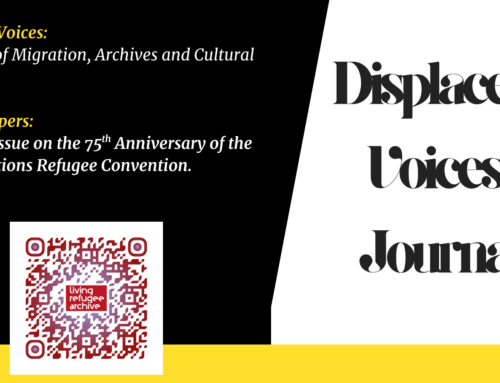
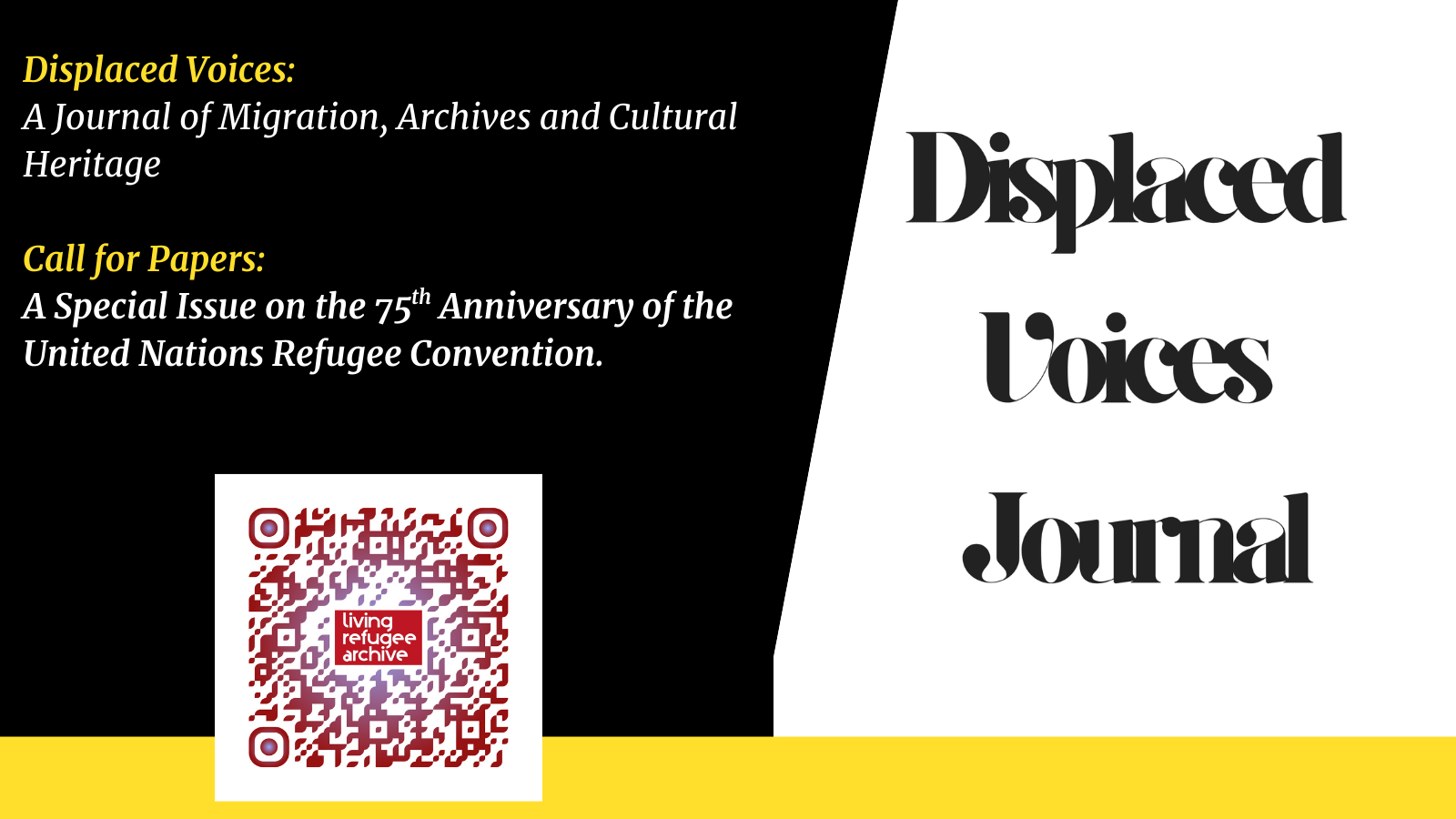
For Refugee Week in June 2020, we were able to launch our new open-access online journal entitled,  Displaced Voices: A Journal of Archives, Migration and Cultural Heritage, (ISSN: 2633-2396). Our aim is for this magazine to engage with issues pertaining to the intersection of refugee and migration studies with participatory archive and oral history methodologies and the role of cultural heritage in relation to the refugee experience. Broad themes will include refugee and migration history; cultural and intangible history; community memory and notions of identity; the role of archives and oral history in documenting the refugee and migration experiences. Our inaugural volume is available open access here: https://www.livingrefugeearchive.org/displaced-voices-volume-1/ and contains a range of articles, poetry, and multimedia resources. We are currently working on the second volume which will be a special edition and preparing new calls for papers for our upcoming volumes.
Over the course of the second half of 2020, we have been able to launch a number of virtual exhibitions, including:
- Amin Kamrani’s 20/20 Virtual Exhibition documenting the impact of the pandemic on local refugee communities in Kuala Lumpur and also his own reflections on being forced to leave Iran for Malaysia. Link – https://www.livingrefugeearchive.org/exhibitions/20-20-virtual-exhibition/
- Virtual Exhibition: In the Gaps – Experiences of Migrant Workers in the Pandemic. Organised in collaboration with the Joint Council for the Welfare of Immigrants and the visual artist Sabba Khan for International Migrants Day 2020 on 18 December 2020. Link – https://www.livingrefugeearchive.org/virtual-exhibition-in-the-gaps-experiences-of-migrant-workers-in-the-pandemic/
- Two exhibitions on Migration Myths and Profiteers of the Hostile Environment developed by Global Justice Bloc for International Migrants Day 2020 – https://www.livingrefugeearchive.org/exhibitions/global-justice-bloc-2020/
- Refugee Psychology and Psychosocial Interventions: A History. A virtual exhibition in collaboration with the UEL School of Psychology as part of the UEL Forced Migration Conference 2020. Link – https://www.livingrefugeearchive.org/virtual-exhibition-in-the-gaps-experiences-of-migrant-workers-in-the-pandemic/
- Digital Storytelling and Education. A collaboration with Professor Giorgia Dona and Jessica Oddy, colleagues at the University of East London. Link – https://www.livingrefugeearchive.org/exhibitions/digital-storytelling/
- Drowning by Numbers (Nergis Canefe). An online virtual exhibition of artwork by Nergis Canefe in conjunction with her article for the first volume of Displaced Voices. Link – https://www.livingrefugeearchive.org/exhibitions/drowning-by-numbers-online-exhibition-by-nergis-canefe/
- Modern Day Slavery: A Journey Ahead to End the Cycle (in collaboration with UEL Undergraduate students) which was also our last physical exhibition in the UEL Docklands Archive prior to lockdown. Link – https://www.livingrefugeearchive.org/exhibitions/a-journey-ahead-to-end-the-cycle/
 The year 2021 should also be a challenge for us and we hope that we will be able to build upon the collaborations and engagements that we have started to create over the course of 2020. As mentioned above, 2021 will also mark the 70th anniversary of the Refugee Council and we are currently in the process of developing a range of activities that we can bring together to help celebrate this milestone, especially around Refugee Week. We also have the Oral History Society virtual conference in the summer where I hope to represent our OHS Migration Special Interest Group, looking at the role of oral history in supporting the collection of refugee and migration narratives. In July we will also be involved in the International Association for the Study of Forced Migration conference: IASFM18 – Disrupting Theory, Unsettling Practice: Towards Transformative Forced Migration Scholarship and Policy, to be held virtually by the University of Ghana, Accra between 26-30 July 2021. We will also be representing our IASFM Working Group on the History of Forced Migration and Refugees.
We hope you find the work that we are doing with the Living Refugee Archive of interest and we would be very interested in hearing your views and feedback on what we have included on the Living Refugee Archive to date and what you would like to see in the future.
Written by Paul V. Dudman.
e-mail: p.v.dudman@uel.ac.uk