

Documenting Chile Archive
Overview
The Documenting Chile Archive was born out of the Crafting Resistance: The Art of Chilean Political Prisoners exhibition which was initially held at the University of Warwick before coming here to the University of East London Archives in 2018 between 26 January and the 16 February, 2018. And was co-curated by Jasmine Gideon, Birkbeck, University of London, and Gloria Miqueles, a Chilean ex-political prisoner.
Crafting Resistance highlighted the importance of material culture and the role of artefacts in helping to challenge the idea of political prisoners as ‘passive victims’ which fails to recognise the degree of agency many prisoners retain despite the horrific circumstances they endured. These artefacts represented a form of testimony to the mental endurance of all those who were political prisoners under the Pinochet regime.
The Crafting Resistance exhibition laid the foundation for our current Documenting Chile Archive. We were able to make a build connections with members of the Chilean diaspora community and to begin to develop conversations around the importance of documenting the cultural heritage and lived experience of the Chilean diaspora in the United Kingdom and consider how such an Archive might work and the scope of the materials it may contain. It was important to take this process slowly in order to begin the process of building trust with the community and to be open about the work we do with the Refugee Archives here at the University of East London and how we could bring our expertise to the table to be able to support an informed project working with the Chilean community.
The Archive
Through ongoing conversations with members of the Chilean community, we agreed to begin our Documenting Chile Archive project with the aim of fully engaging with the Chilean community to explore how an Archive to document the lived experiences of Chileans in the United Kingdom might appear. As part of our ongoing community-focused archiving remit with both the UEL Archives and the Living Refugee Archive virtual portal, we wanted to ensure that this would be a collaborative and participatory project to work with Chileans to help us better understand how we could better understand how such an Archive could be developed to represent the lived experience of the community, both in terms of the range of scope of archival materials we might collect and also the ethics of engagement as a continuous process of learning from the community about their history and how we as an archive organisation can help facilitate the safeguarding, preservation and access to these histories.
We already had a small collection of reports and publications on Chile as a part of the Refugee Council Archive that we hold here at UEL. The Refugee Council helped in supporting some of the Chilean exiles arriving in the UK and was also one of the charitable organisations that helped to establish the
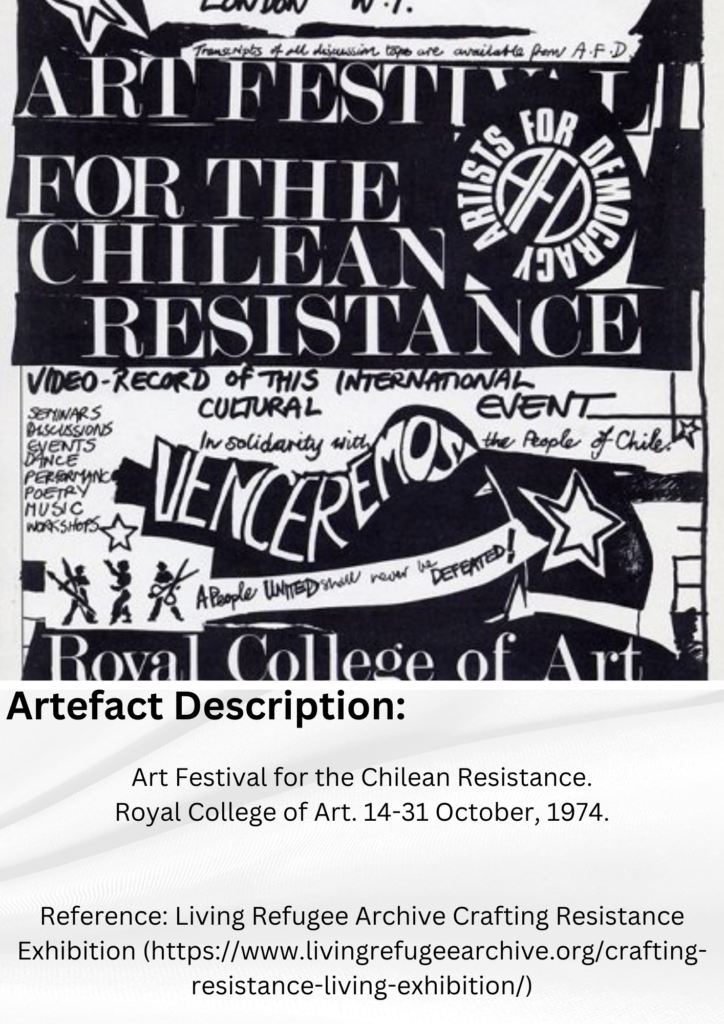
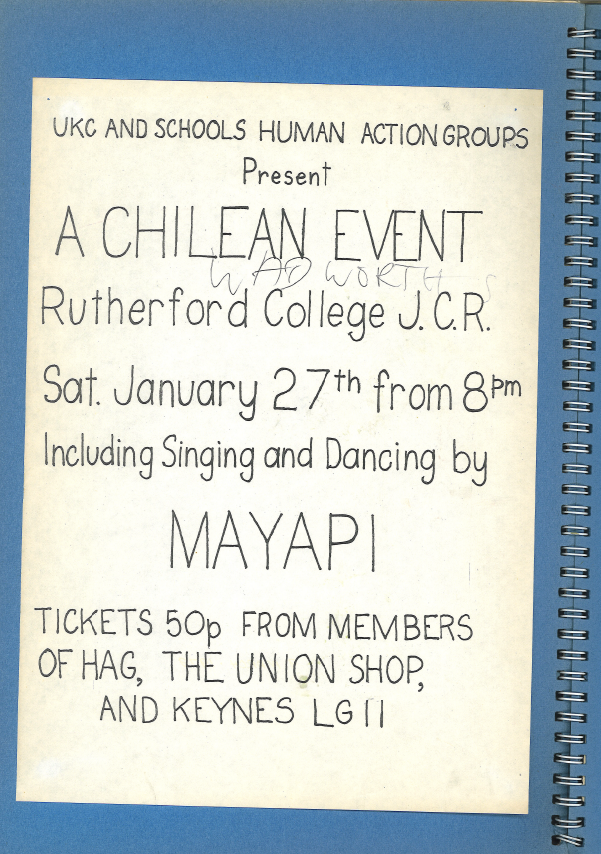
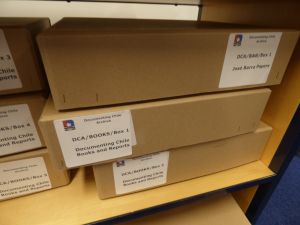
Our Documenting Chile Archive has already received several deposits of new materials from Chileans in the form of photographs, press cuttings, posters, written accounts, poetry, music, DVDs, reports and books. These resources provide a lasting documentary mark on the lives experiences of Chileans, their resilience in the face of exile and the solidarity movements that were established within the UK. Documenting Chile will not just represent one narrative, but a representation of many narratives and histories reflected in the range and scope of materials that may eventually form a part of the Archive.
| Named Deposits Include: | |
|---|---|
| Cara Diego | Juan Cava |
| Carlos Gonzalez | Mauricio Redikes |
| Familia Cordero | Mayapi |
| Familia Valencia | Nelsa Silva |
| Familia Vega-Ramirez | Nidia Castro |
| Gloria Miqueles | Roberto & Eysen Vsaquez |
| ICAL-Chile | Sergio Marras |
| Jose Barra | Stella Franceskide |
| Juan Carlos Garcia | Carol Lasbrey |
We are specifically conscious not to limit ourselves to the more traditional notions of the Archive, namely dusty boxes of documents tucked away in basement, that rarely see the light of day. For us, we have a commitment to the “living archive” methodology which challenges traditional archival collecting models which reflect a more colonised model of collecting in favour of a more decolonised approach supporting participation in all aspects of the archival process, encouraging the reconnection with the tangible and intangible cultural heritages associated with communities and which supports active engagement with both the archives and the processes that underpin them. Archives should not exist in isolation from the communities that they represent and through this project we hope to engage with the Chilean community to create a genuinely participatory and collaborative archive for engaged with the shared history and empowerment though `informed custody.’