Refugee History: See How They Live – Hong Kong Refugee Exhibition for World Refugee Year 1959 Souvenir Programme
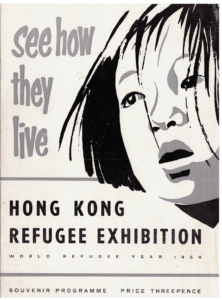
During this extended peritod of lockdown due to the COVID-19 pandemic, I have had time to explore new and different avenues for how we look to collect archival materials exploring issues in relation to refugee history. As part of this work I had set up a number of Ebay email alerts relating to refugee and forced migration issues. One of the items I discovered and subsequently purchased through this process for the Refugee Council Archive at UEL was a souvenir programme which will be the subject of this blog post.
The item in question is entitled: “See how they live. Hong Kong Refugee Exhibition for the World Refugee Year 1959.” The front page indicates it was a souvenir programme with a price of Threepence for the `See how they live’ exhibition curated by the Inter-Church Aid and Refugee Service based in London, with the exhibition being devised and designed by a Maurice Richards from Contact Studios.
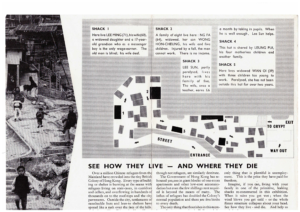
The souvenir programme is designed to accompy the exhibition and to give a very brief insight into the fundraising work of the Inter-Church Aid and Refugee Service. The exhibition itself focuses on reconstructing how Chinese refugees who have sought refuge in the Briitsh-held colony of Hong Kong are force to live in low quality “ramshackle” accomodation and to highlight the very limited opportunities for employment and resettlement that are open to them.
The exhibition itself was located at St. Martins-in-the-Fields and took the form of a reconstruction of a Hong Kong street that attendees could walk through and “visit” five different shacks as examples of how Chinese refugee families were forced to live. The aim being to encourage awareness of their situation and to facilitate donations to the Inter-Church Aid and Refugee Service to help them establish a “£200,000 vocational training centre for 300-400 Chinese refugees.”
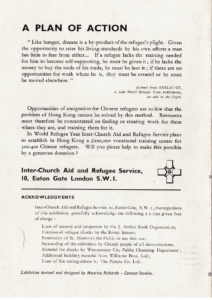
The souvenir programme in retrospect is dated in terms of how it approaches representing the experiences of Chinese refugees in Hong Kong at that time, both in its design and the language used. However, as an historical archive item, I felt this was an important addition to the Refugee Council Archive as an example of action undertaken in support of World Refugee Year 1959. It is not something that we were aware of prior to it appearing on Ebay, so we felt this was an important addition to the Archive and to the wider refugee history narrative here in the UK. It will also be useful from a visual perspective, as an example of early visual responses to representing refugee experiences to help raise awareness of their situations.
The Inter-Church Aid and Refugee Service Archives are held at SOAS Archives and Special Collections and their online catalogue is accessible via the Archives Hub at: archiveshub.jisc.ac.uk/search/archives/e28cf4b4-f121-3158-8426-c74013a59242
Please do drop us a message if you have come accross any additional information on this Exhibition, it would be interesting to learn more about it? You can contact me, Paul Dudman, on p.v.dudman@uel.ac.uk.