

The UEL Forced Migration Conference 2020
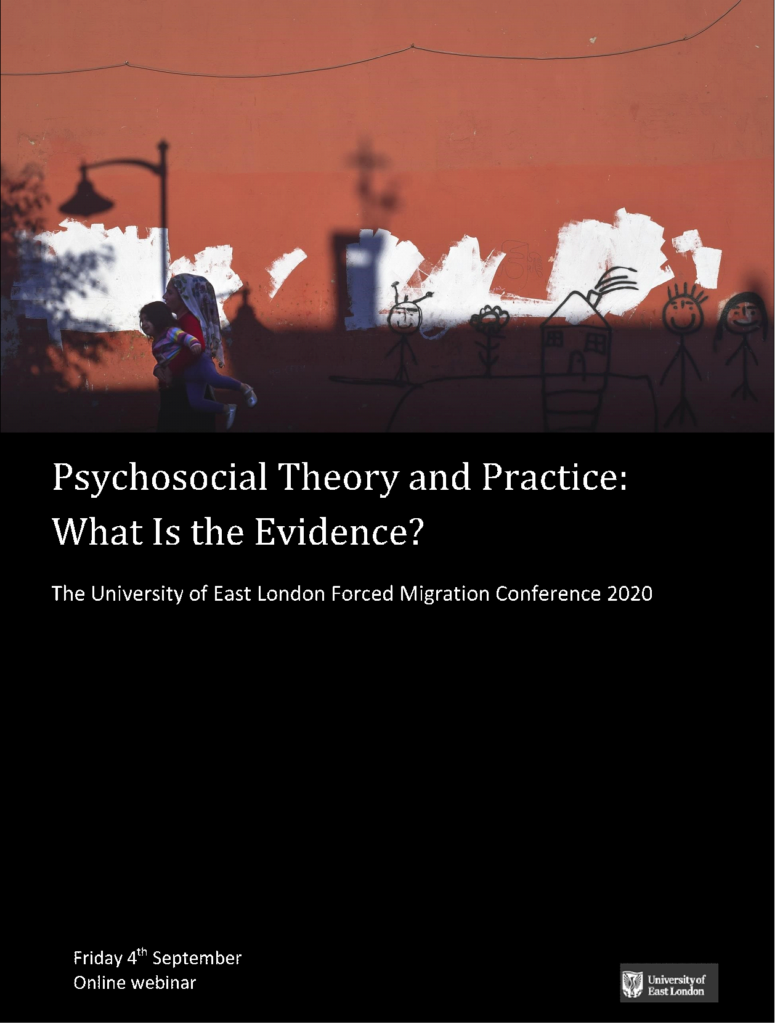
The UEL Forced Migration Conference 2020
Hosted by the University of East London (UEL) Psychology Department
Psychosocial theory and practice: What is the evidence?
The University of East London Forced Migration Conference 2020 provides a platform for forced migrants (including refugees, asylum seekers, those who have had the experience of being internally displaced, undocumented migrants and other people with a precarious immigration status), as well as scholars, researchers, policy makers and practitioners who work in the field (e.g. humanitarian workers, NGO workers, or service providers). This platform is intended to promote knowledge exchange, challenge existing conceptualisations of what ‘psychosocial’ means in relation to forced migration, and propose alternative psychosocial practices (particularly evidence-based interventions).
In the contemporary context, issues of forced migration and ‘the refugee’ have become symbolic of wider social, cultural, epistemic, economic, political and psychological processes. One example is the securitisation of migration, bordering practices and representing the refugee as an emergency, a crisis or a problem to be solved. If we are to participate and promote a more ethical approach, the context out of which psychosocial theory and practice emerges, should be critically deconstructed.
The Mental Health and Psycho-Social Support (MHPSS) approach understands ‘mental health’ as existing within the individual psyche and ‘psychosocial’ as the interconnection between the person and their environment. In terms of the operationalisation of this paradigm, psychosocial support is often delivered through interventions that focus on behaviour, emotions, cognition, functioning and changes in relationships. Interventions themselves are varied, from women’s groups to one-to-one counselling. These interventions are also delivered by a wide range of actors – from professionals with no related training to specialists in the field. In summary the field of MHPPS is broad and complex, it is based on a particular understanding of what constitutes wellbeing, and its areas of policy and intervention are extremely diverse.
The Event
This one-day event showcasing the perspectives of over 20 speakers who have had the experience of migrating across borders because of conflict, persecution or natural disasters, as well as academics and practitioners working in this field.
Date: Friday 4 September
Time: 10:00 – 19:00 GMT
Location: online
Fee: £20
A number of free tickets are reserved for refugees, asylum seekers, those who have had the experience of being internally displaced, undocumented migrants and other people with a precarious immigration status.
A number of tickets will also be offered to student ambassadors who offer to contribute their support on the day of the conference.
Registration
Registration is now open.
Registration is online only and payable (£20) by card, we are unable to accept registrations over the phone and invoices cannot be provided.
Register for the event here.
People who have experienced migration: A number of free tickets are reserved for refugees, asylum seekers, those who have had the experience of being internally displaced, undocumented migrants and other people with a precarious immigration status. If this applies to you, email ForcedMigrationConference@uel.ac.uk and write ‘Registration – lived experience’ in the email title, along with your email request.
What does my conference registration include? Your conference registration includes access to all of the academic conference sessions and the conference programme.
Student Ambassadors: A number of tickets will be offered to student ambassadors who offer to contribute their support on the day of the conference. Student ambassadors would be assigned to specific task/s on the day e.g. registration (details would be provided with the specificities). In return, student ambassadors would be able to attend the majority of the event for free. If you are a student at the University of East London and would like to apply to be a student ambassador at the conference, email ForcedMigrationConference@uel.ac.uk and write ‘Registration – student ambassador’ in the email title, along with your email request. The deadline for requests to be a student ambassador is 30 June 2020.
Programme.
Download the Programme.
Timeline.
June 2020 – Call for contributions
Extended to 13 July – Deadline for submission of abstracts and poster presentation
August 2020 – Outcome notification of abstract and poster submission
June 2020 – Programme (draft) available online
30 June – Deadline for requests to be a student ambassador
4 September – The UEL Forced Migration Conference 2020
Call for Contributions.
Who can contribute?
We welcome submissions from:
People who have had the experience of ‘forced migration’ (including refugees, asylum seekers, those who have had the experience of being internally displaced, undocumented migrants and other people with a precarious immigration status)
Scholars
Researchers
Policy makers
Practitioners who work in the field (e.g. humanitarian workers, NGO workers, or service providers)
Content
Contributors are invited to submit abstracts addressing psychosocial theory and/or practice through either:
Lived experience
Professional practice
Research
Theory/opinion paper
Contributors are invited to critique issues pertaining to psychosocial theory and/or practice. Case studies/examples are welcome when discussing the chosen topic, as is how research can influence policy agendas. Examples of topics that could be explored include but are not limited to:
Psychosocial theory and practice: What is the evidence?
Definitions of ‘mental health’ and ‘psychosocial’
Innovative work related to wellbeing and forced migration
Innovative psychosocial practices
MHPSS conceptualisations of wellbeing: mental health vs mental disorder: The dominant discourse in psychology and the humanitarian sector
The impact conflict and displacement can have on individual and community wellbeing: A psychosocial perspective
Representations of ‘the refugee’ in psychology
Psychological perspectives on forced migration and othering/ belonging / identity politics / agency
The intersection between psychology, politics and the securitisation of forced migration
Cultural conceptualisations of psychosocial theory and/or practice
Psychological paradigms used to understand mental health and psychosocial support and their relationship with the Global North and Global South
Context-specific psychosocial issues e.g. camps
Evidence-based mental health and psychosocial interventions
Measuring the efficiency of mental health and psychosocial interventions
Who should deliver mental health and psychosocial interventions?
Psychosocial interventions and funding
Country-specific mental health infrastructure and psychosocial interventions
Regional psychosocial interventions in Africa / Australia / Europe / Asia / South America
Psychosocial interventions in countries that are not signatories to the 1951 Refugee Convention
Internally displaced people and psychosocial interventions
The ethics of mental health and psychosocial interventions
Gender and psychosocial interventions
Decolonising psychosocial theory and/or practice
Guidelines on psychosocial interventions
The implication of the Global Compact on Refugees on psychosocial theory and/or practice
The impact policy has on psychosocial interventions
Psychosocial theory and practice: A critical psychology perspective
Reconstructing Psychosocial Theory & Practice
Call for contributions: abstract submission
Contributors selected will be invited to present for 20mins during the workshop streams. They can either deliver:
A presentation (15mins presentation and 5mins discussion with audience)
A workshop (20mins interactive workshop)
Open debate (20mins of facilitated open debate)
Roundtable discussion (20mins discussion) – must be more 2 or more contributors
Abstract submissions: Structure of the contribution
All abstract submissions should be:
250 words in length
Not include references
Not include the author(s) name or any indication of the organization they work with
Be grammatically correct and written clearly
Indicate the mode of delivery (presentation/ workshop/ open debate/ roundtable discussion)
PLEASE NOTE: If the presentation is on research that is not complete or there are no findings, please submit a proposal for a poster presentation instead
Abstracts: How to submit
The deadline for submission is: 26th June (extended date)
Email: ForcedMigrationConference@uel.ac.uk
In the header of the email write: ABSTRACT SUBMISSION
Attach the abstract as a word document (no identifying information – see ‘structure of submissions’ for more information)
On a separate word document, include your biography (250 words max)
Confirmation of submitting your abstract will be sent to you via email.
Final decisions on abstracts submitted will be made by the end of May.
Please note submissions will be selected in line with the conference objectives and informed by principles of equality, intersectionality, creativity and diversity.
Call for contributions: Poster Presentations
Early career researchers, doctoral trainees and Masters students, recently qualified psychologists and trainee psychologists are invited to submit poster presentations.
Poster Presentations: How to submit
The deadline for submission is: 26th June (extended date)
Email: ForcedMigrationConference@uel.ac.uk
In the header of the email write: PROPOSAL FOR A POSTER PRESENTATION
Attach the abstract as a word document (no identifying information – see ‘structure of submissions’ for more information)
On a separate word document, include your biography (250 words max)
Posters should be A0 in size and Portrait.
Confirmation of submitting your abstract will be sent to you via email.
Final decisions on abstracts submitted will be made by the end of May.
Please note submissions will be selected in line with the conference objectives and informed by principles of equality, intersectionality, creativity and diversity.
Location and Attendee Information
Location: online
After registering, see the ‘book now’ tab. You will be sent details of how to log on 24 hours before the event.
Contact and Social Media
Conference organisers
Dr Claire Marshall and Professor Rachel Tribe (University of East London, Psychology Department)
Email: ForcedMigrationConference@uel.ac.uk
Follow us on Twitter @UELPsychLondon and use #UELForcedMigrationConference