Guest Post:
Leicester’s Gujarati Inheritance
By Helen King.
(PhD Researcher with the Northern Bridge Consortium Doctoral Training Partnership based at Newcastle University).
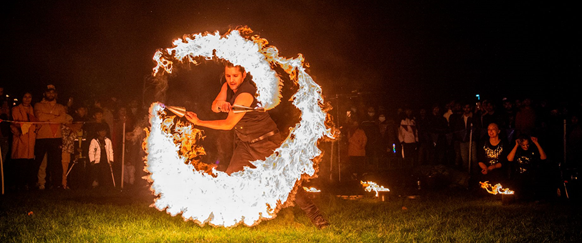
2021 Diwali celebrations in Leicester. Photo: Ian Davis, Leicester Mercury.
When I was growing up in East Anglia, my dad commuted to Leicester for work. Occasionally he would take me with him, and I would sit with my colouring pencils in the back of a lecture or a meeting. When he was finished we would have the rest of the day out around Leicester, and one autumn, when I was quite small, I remember being excited at dusk to see what I thought were Christmas lights up already in the streets. It was explained to me that these were actually for Diwali, the festival of light that is celebrated every autumn by Hindus, Sikhs and Jains to signify the triumph of good over evil. Revisiting these associations as an adult for my exploration of the Gujarati Yatra archive, I have learnt that these Diwali light displays are part of Leicester’s inheritance from the East African Asians who came to the city in the 1960s and 70s. Whilst many of the participants in the Gujarati Yatra project are Londoners, Ugandan born Jaffer Kapasi settled in Leicester, and his oral history offers an opportunity to delve into this inheritance.
Leicester is a city in the East Midlands, with a population of 357, 000 in 2019, and one of the most ethnically diverse cities in the UK. Leicester’s prosperous garment and hosiery industries has attracted successive waves of immigrants since the 19th century, among them the few thousand Kenyan Asians who came to Leicester in the late 1960s in response to Africanisation in Kenya. This meant that by the time of the Ugandan exodus in 1971 there was already an established Gujarati community in Leicester. However, Leicester was not initially welcoming to the East African Asians from Uganda. Upon Idi Amin’s announcement that all Indians would have 90 days to leave Uganda, Leicester City Council published a notice in the Ugandan Argus on 15 September 1972 urging them to ‘accept the advice of the Uganda resettlement board and not come to Leicester’ on the grounds that housing, education and social services were stretched. Whilst this notice has become a well-known sign of British resistance to the East African Asians, it backfired by letting incoming Ugandan Asians know that Leicester existed and already had an established East African Asian community (Mamdani).
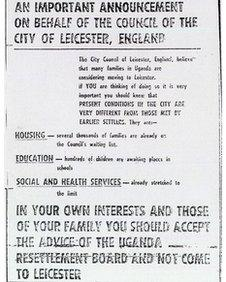
The notice in the Uganda Argus 15/09/1972 discouraging immigration to Leicester
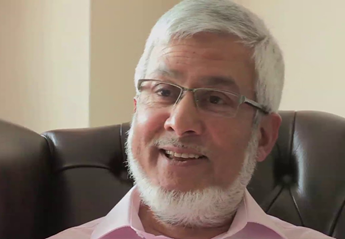
Jaffer Kapasi OBE, being interviewed for the Gujarati Yatra project.
Jaffar Kapasi OBE, a Leicester businessman and community leader, remembers the notice in the Ugandan Argus well. When he arrived in the UK at Stansted airport, along with his parents, four brothers and two sisters, they were transferred to Lingfield army barracks, and then on to an army barracks in Wales. Despite the hostile reception from Leicester City Council, the city was an was an attractive prospect, with an established Gujarati community where they could access good food, speak their language and practice their culture and faith. It was Kapasi’s father in the end who said: ‘It doesn’t matter if they don’t want us to come to Leicester, I think we should do that. We should go and see what the Leicester is all about’ (‘Jaffer Kapasi’, 1.29.27-1.29.34).
Through friends, the family located a house in Thurmaston, a village on the outskirts of Leicester. Kapasi’s young brother was especially shocked by the sight of compact terraced homes with no gardens and a toilet outside. There was some difficulty with one of the neighbours, who ‘would not talk to us for quite a few years because we used to cook curry in our home’ (1.33.21-1.33.28). Kapasi’s father struggled to find work as his English was limited, but he eventually became the keeper of a shop, the Mini Supermarket, opened by his sons on Melton Road. Kapasi reflects that East Africa Asians changed the shopping culture in the UK by opening shops like this that were open all hours, and by shaping business in Leicester. Furthermore, he credits Gujaratis with reinvigorating the fabric industries in the midlands and providing employment for up to 60,000 people in Leicester.
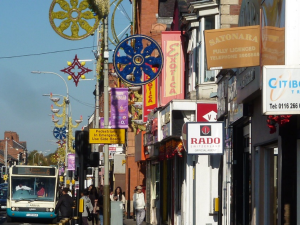
The Golden Mile during Diwali 2011. Image courtesy of Kiran Parmar, Flickr
By 1978, Leicester Community Relations Council estimated that there were over 10,000 Ugandan Asians in the city, a large proportion of whom were Gujarati (Marett). But for Pippa Virdee understanding Gujarati Leicester ‘is much more about the narrower spaces, wards, or to use the Indian term mohallas. Asian Leicester is therefore, Belgrave, Highfields, Rushy Meads, Evington and Latimar; the areas most associated with Asians in Leicester’. Belgrave Road, a street to the North of Leicester city centre, as Kapasi explains, was rundown and earmarked for demolition before the arrival of Leicester’s East African Asians. Belgrave Road and the adjoining Melton Road are now referred to as the Golden Mile, having been regenerated by the vegetarian restaurants, sari boutiques and jewellery shops established by Leicester’s Asian community. Ugandan Asians such as Kapasi have undoubtedly changed the face of Leicester, and as a community he continues to push for more, including lobbying the council for better wheelchair and pushchair access along the Golden Mile. Leicester is a religiously diverse city, as is the Gujarati community, whose members belong to many faiths. The numerous places of worship within Leicester are a testament to this. Kapasi, a Muslim belonging to the Bohra community, expresses pride both in his own flourishing faith community, and in the religious plurality of Leicester’s Gujarati community.
Leicester has become known globally for its Diwali festival, which takes place primarily along the Golden Mile. The now famous public light display in Leicester was first lit in 1983, and is likely the largest celebration of Diwali outside of India. Kapasi describes how the Diwali festivities that I first saw as a child attract ‘between 50 to 60,000 people who come on the Diwali festival to Belgrave Road. These are people who come from Norway, from Sweden, Scotland, Wales’ (1.44.56-1.45.07). As well attracting international visitors of diverse creeds and backgrounds, Diwali is also a lucrative time on the Golden Mile, bringing customers from far afield.
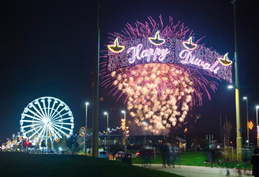
Diwali celebrations. Photo: https://www.storyofleicester.info/faith-belief/diwali-in-leicester/
After completing university and accountancy training, Kapasi set up his own financial consultancy business. He was awarded an OBE in 1997 for his contributions to business. This success and his role as a leader in the community enabled him to reforge a link to his country of birth. In a visit to London in the late 1990’s President Museveni of Uganda appealed to the East African Asians of the UK to reinvest in Uganda, imploring them to forgive the actions of his predecessor: ‘Amin was wrong; don’t punish your home’ (Tripathi, 130). The President also encouraged Ugandan Asians to invest in or return to Uganda; many have since done the former, and a few have returned to set up businesses once again. Kapasi has visited Uganda on two occasions and noted the need for investment to boost the country’s infrastructure. In 2015, he was invited to become the Honorary Consul of Uganda in the Midlands. President Museveni designated the role for someone who could ‘promote trade and peace, bring people in’ (1.56.07 – 1.56.11). In this role, Kapasi works to build economic, social and cultural bridges, and promote bilateral trade and investment between the UK Midlands and Uganda. In his role as a Leicester businessman and as Honorary Consul of Uganda, Kapasi is emblematic of the Gujarati community in Leicester. Having transformed run-down areas of Leicester into thriving hubs of business, the Leicester Gujaratis are now reforging business connections with the India and East Africa, which positively impacts the prosperity of the Midlands, and the UK as a whole.
Bibliography
Mamdani, Mahmood, From Citizen to Refugee: Uganda Asians Come to Britain. London, Pinter Publishers, 1973.
Marett, Valerie. “Resettlement of Ugandan Asians in Leicester.” Journal of Refugee Studies, vol. 6, no. 3, 1993, p. 248-259. HeinOnline, https://heinonline.org/HOL/P?h=hein.journals/jrefst6&i=260.
Tripathi, Salil. “Powers of Transformation.” Index on Censorship, vol. 32, no. 2, Apr. 2003, pp. 125–131, doi:10.1080/03064220308537225.
Virdee, Pippa. From the Belgrave Road to the Golden Mile: The transformation of Asians in Leicester. Unpublished working paper, University of De Montfort, 2009.
‘Jaffer Kapasi’, UEL Archives and Collections, Gujarati Yatra Collection, accessed 11 December 2021.
LRA Blog Disclaimer
The views expressed on this blog are attributable to their individual authors writing in their personal capacity only, and not to any other author, the editors, or any other person, organization or institution with which the author might be affiliated unless explicitly stated so.