Guest Post:
Bhradra Vadgama and Niranjana Desai: a moment in multicultural education
By Helen King.
(PhD Researcher with the Northern Bridge Consortium Doctoral Training Partnership based at Newcastle University.)
For those East African Indians who migrated to the UK as citizens of the British empire in the 1960s and 70s, locating one’s identity in relation to place is a complex thing. Speaking after over 40 years living in the UK, Bhadra Vadgama describes a sense of rootedness: ‘I am more rooted, because my Gujarati is so good’ (1.12.15-1.12.19). Responding to the changes in the UK education system brought about by the advent of the National Curriculum, Niranjana Desai, former teacher and member of the Gujarati diaspora advocates for the continued importance for children of the diaspora to learn Gujarati:
What is important? Gujarati is important. It is your mother tongue. And I believe firmly, that if you are well versed in your mother tongue, whatever the mother tongue is, Gujarati, or Urdu, or whatever, you can do well in other languages. (1.48.08-1.48.31)
As these Gujarati women reflect on the importance of language in lives, their oral histories, collected as part of the Gujarati Yatra project, give a glimpse of 1970s London, where Gujarati literature and multicultural education flourished. As employees for several decades of the Inner London Education Authority, and at different times holding the position of Vice President of the Gujarati Literary Academy, the passion Vadgama and Desai share for Gujarati education is a snapshot of the impact of the members of the ‘double diaspora’ upon the educational and literary landscape of the UK (Parmar, 1).
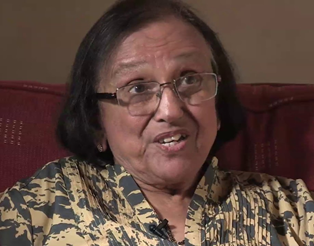
Bhadra Vadgama being interviewed for the Gujarati Yatra project
Bhadra Vadgama was born in Zanzibar in 1940, the daughter of Kutchi parents who had travelled from Gujarat. In some ways, the Zanzibar of her childhood was for her ‘like Ramarajya’ (7.07-7.09), the kingdom of Rama, an ancient utopian vision of society. Within this idyll, she also recalls blackening the windows due to the fear of bombardment during WWII, and a trip to India before Partition in 1947 during which she witnessed ‘dead bodies being driven on the tangas in Mumbai’ (35.03-35.06). Vadgama’s key memory of her primary schooling in Zanzibar is feeling a sense of her Indian identity. She went to a free girl’s primary school for Hindus, for which the medium was Gujarati. There she learnt Indian dance and song, and was taught to celebrate Indian history and culture. She describes feeling ‘really Indian’ (10.57-10.59). The importance of preserving culture and passing it on through education can be traced as a core value of Vadgama’s career. Working as a teacher in Kenya for several years, Vadgama and her husband decided to move to the UK in the mid-1970s. Gaining a librarianship qualification, she got a job with the ILEA, working for the school library service.
The Inner London Education Authority managed the educational requirements of the 12 London borough councils from 1965-1990. Vadgama describes the ILEA as an ‘advanced and liberal authority’ (56.51-56.54), and in her first library position she was given half a day a week off to study services for ethnic minorities. In 1977 she was employed to run a new library service unit for ethnic minorities in Wandsworth. This job was funded according to Section 11 of the 1966 Local Government Act, which provided grants for local authorities to employ staff who could cater to the specific needs of Commonwealth immigrants, such as those who had come in numbers in the Uganda exodus of 1972. Vadgama describes the time between 1977-99 when she worked for the library service as ‘the peak of multiculturalism’ (1.06.16-1.06.20). For Vadgama, this job was ‘a turning point in my life’ (58.36-58.38), and a convergence of her skills and passions. However, Vadgama’s interest in Gujarati – her passion for its language and literature – was also deepened during her time in this job.
Vadgama’s involvement with the Gujarati Literary Association began around this time. The Gujarati Literary Academy was formally established in 1977, having previously existed as the Gujarati Sahitya Mandal, linking literary activities taking place in London, Birmingham, Leicester and Coventry. The GLA exists to this day to bring together members of the Gujarati diaspora, and to promote Gujarati literature and language, and its slogan is ‘Let’s listen to Gujarati, speak Gujarati, read Gujarati, write Gujarati, live Gujarati’. For Vadgama, the GLA does important work in immersing members of the diaspora in the language and literature of Gujarat, giving them the sense of rootedness that she derives from her connection to her mother tongues, Gujarati and Kutchi. Vadgama is the GLA’s current Vice President.
Although they are connected as members of the ILEA and the GLA, the parallels between Vadgama’s and Desai’s histories emerge earlier in their shared passions for teaching and for the flourishing of Gujarati in the UK. Desai was born in Jinja, Uganda, in the early 1930s. She inherited a love of literature from her parents, who had both moved from Gujarat to work as headteachers in Jinja. Desai shares with Vadgama memories of a happy childhood that was nonetheless marked by WWII. After her father died suddenly, Desai was sent to boarding school in Mumbai in 1940 along with two of her siblings; due to the ongoing war, Desai was unable to see her mother for another six years. Yet despite this hardship, Desai describes her time in Mumbai as a ‘golden period’ (14.21). Living in Matunga, a Mumbai locality famed at the time for ‘Holywood Lane’, Desai remembers playing with Raj Kapoor, the well-known actor of Hindi cinema. The children in Matunga were encouraged write and to perform, but also to demonstrate in the Quit India movement for independence from British rule in 1942.
hen she returned to Uganda, her secondary school in Kampala similarly encouraged the students to put on plays and teach each other dance and poetry. This child-led approach to education is a thread running through Desai’s own career as a teacher. Her first opportunity to develop this approach came at Ramnarain Ruia College in Mumbai, when she took up a certificate with the Balkan-ji-Bari, a charity providing education and cultural opportunities for under-privileged children. Desai’s philosophy of teaching is apparent in her description of this time and she credits the children with teaching her Marathi. In her job at Kololo Secondary School in Kampala, she pushed for more child-led activities, including a Gujarati literary association run by her students. She says that: ‘children have got so much that we as teachers can learn from them’ (1.00.03-1.00.7).
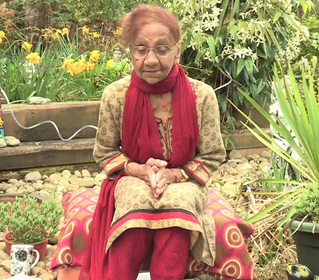
Nirinjana Desai being interviewed for the Gujarati Yatra project
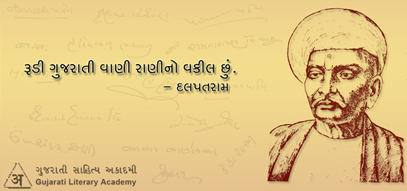
The Gujarati Literary Academy: www.glauk.org
When she moved to the UK in 1961, Desai found work as a teacher for the ILEA in Hackney and then in Harrow. She was committed to teaching Indian culture and dance to her classes of white pupils. After the Ugandan exodus in 1972, Desai set up the Harrow Women’s Association for the Gujarati women coming into London, but also for all local women, confronting domestic violence and poor mental health. In her time as a Curriculum Development Officer in Brent, Desai advised on the promotion of Asian languages and literature. Bilingualism was encouraged, with Urdu and Gujarati taught to GCSE level. Desai remembers the huge freedom that she was given in this job, but laments the changes that came about in the late 80s. The ILEA was abolished in 1990, following the Education Reform Act of 1988, and its responsibilities passed to the London boroughs. The Act of 1988 also brought in the National Curriculum, setting out national requirements for the education of pupils in England and Wales. Desai argues that the National Curriculum placed a ‘burden to the children’, leaving them no time to explore their Gujarati language and heritage (1.47.02-1.47.05). Desai was a founding member of the Gujarati Literary Academy. She was heavily involved in the Gujarati Sahitya Mandal in the early 70s. When the Gujarati Literary Academy was officially constituted in 1977, Desai became the vice president. Operating to this day, the GLA carries the legacy of this period in UK history when the landscape of education in London and other cities throughout the UK was transformed and enriched by the presence of the Gujarati diaspora.
Bibliography
Desai, Nirinjana. “Nirinjana Desai oral history interview conducted by Lata Desai and Rolf Killius in London, UK, 2/4/2017”. UEL Archives and Collections, Gujarati Yatra Collection. Accessed 24th Nov 2021.
Parmar, Maya. Reading Cultural Representations of the Double Diaspora: Britain, East Africa, Gujarat. Springer International Publishing, 2019.
Vadgama, Bhadra. “Bhadra Vadgma oral history interview conducted by Lata Desai and Rolf Killius in London, UK, 11/3/2017”. UEL Archives and Collections, Gujarati Yatra Collection. Accessed 28th Oct 2021.
LRA Blog Disclaimer
The views expressed on this blog are attributable to their individual authors writing in their personal capacity only, and not to any other author, the editors, or any other person, organization or institution with which the author might be affiliated unless explicitly stated so.