Reflection on the We Are Archive Event at Hackney Archives and the Civic Voice Archive at the PEER UK Gallery in Hoxton.
By Paul V. Dudman
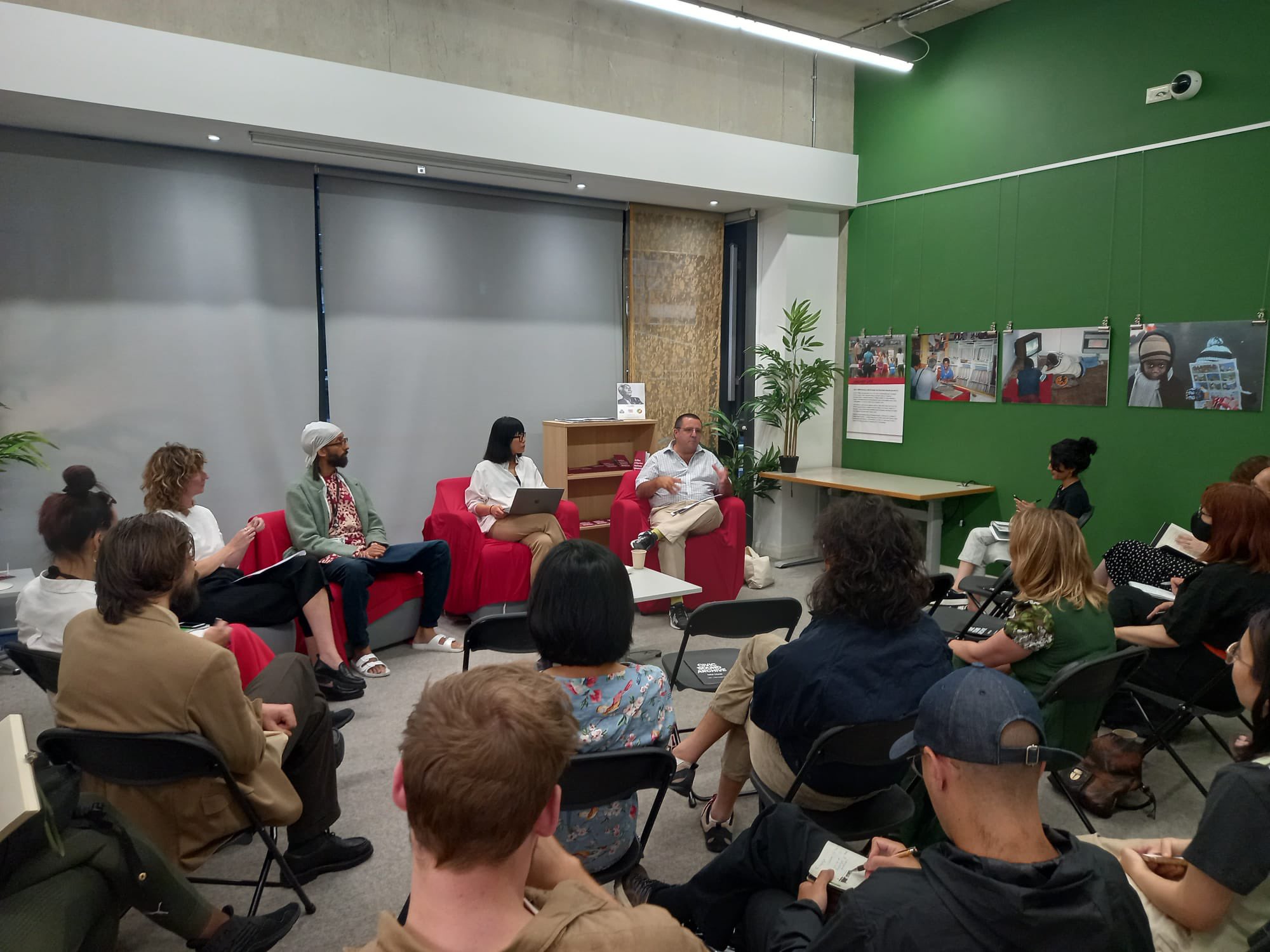
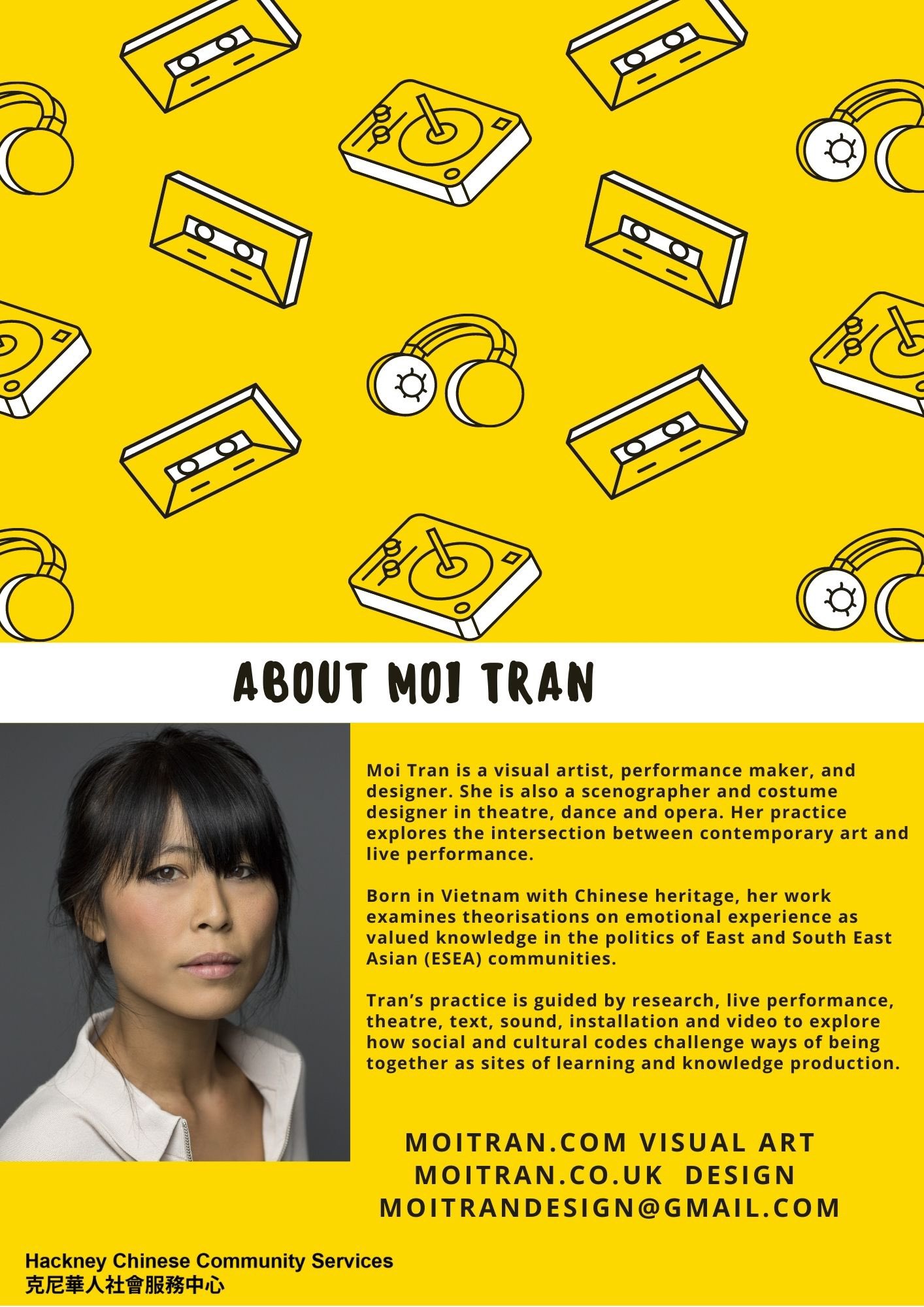
For the past two years, we have been fortunate to be able to work with Hackney-based performance artist Moi Tran on the Civic Sound Archive (incorporating the Sound Chorus) project funded by The National Archives Testbed Fund. As a part of the first public exhibition of the Civic Sound Archive at the Peer Gallery in Hoxton between 10th June and 13th August 2022, the We Are Archive Discussion Event was held at Hackney Archives on
Joining Moi Tran on the panel for this event was Dr. Etienne Joseph, Director of Hackney Archives; Ellen Grieg, Director of the Peer Gallery and myself, Paul Dudman, representing UEL Archives and the Living Refugee Archive. In the very intimate and welcoming environment of Hackney Archives, and with an engaged audience, a lovely discussion was held on the importance of Moi Tran’s work with the Civic Voice Archive, which aims to document the history of Vietnamese and Southeast Asian community history through the mediums of sound and performance. Issues were also raised and discussed about what constitutes an “archive” and how archival organisations like the University of East London (UEL) and Hackney Empire can look to work collaboratively with local communities to help to support communities with ensuring that their histories can be both collected, preserved, and made accessible in ways which continue to engage with the communities that we serve.
It is interesting that our work with Moi Tran has coincided with the important work being undertaken to help conserve and preserve the An Viet Foundation Archive in Hackney. The An Viet Foundation was a vital community organisation set-up to help support Vietnamese refugees arriving in Hackney during the late 1970’s and continued to play an active role in the community for many years. Following its eventual closure, the An Viet House in Hackney was subsequently taken over by squatters, and their archive documenting the invaluable work of the organisation for over three decades unceremoniously dumped on the roof. I was first alerted to this by a newspaper article in Hackney Citizen (Sheridan, 2019) and continued to work with Hackney Chinese Community Services and Dr. Etienne Joseph and Diane Le at Hackney Archives, who were fortunately able to secure a Covid-19 Emergency Fund from The National Archives to enable the emergence conservation work to be undertaken on the An Viet Foundation Archive. Longer term storage of the collection is being worked on as we speak so from the almost disaster of a lost community history there is now hope that this important Archive can be preserved and made accessible again both to the community in Hackney and for longer term research.
Whilst this work was going on, in 2021, I was able to arrange for an online interview between Akinpelu Funmilayo, who was doing a virtual internship at the Living Refugee Archive, and Moi Tran, which resulted on the following guest post on the Living Refugee Archive: A Conversation with Moi Tran, on the Civic Voice Archive, Radical Archiving and Everything In-between by Akinpelu Funmilayo.
In an early reflection in the post, Moi Tran is quoted as saying: “for me, I always am interested in telling stories that perhaps are wedged or live in between the lines, in the same way I celebrate marginalised spaces, as spaces of radical knowledge making.” (Funmilayo, 2022). Moi Tran has a strong interest in exploring and challenging the underlying archival paradigms that have been established over the years to underpin established notions of archival science. I think this was definitely something that clicked for us in our very first meeting together in 2020, albeit online, after being introduced by a mutual friend. Our initial meeting quickly led to a funding application to The National Archives Testbed Funding programme.
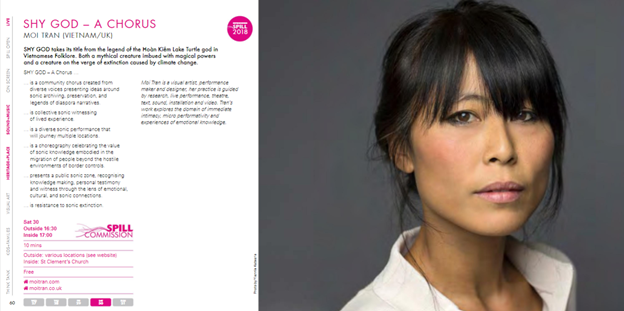
Our project was entitled “Disrupting Archives Project” and represented a collaboration between the UEL Archives and Moi Tran, a performance Artist based in Hackney, East London (www.moitran.com / www.moitran.co.uk). Through her work, Moi Tran aims to explore creative methods to disturb and challenge traditional archives usage and structure, including taking agency in narrative as activism, promoting conventionally subjugated knowledge systems through archival processes and to explore contemporary arts practice in a community archive.
This project will explore innovative new ways of archiving community history and narratives through live performance. It will consider how multiple elements can be utilised to form an open creative witnessing of underrepresented narratives and enable new forms of representation within the archive for these communities.
Our aim was to utilise `the archive as a portal to celebrate alternative modes of knowledge making through lived experience in the Diaspora,’ and Moi Tran `aims to create an anecdotal set of archives, which will include overlooked materials, records usually omitted from conventional archives to activate and to take agency of the Southeast Asian / East Asian lived experience and narratives.

We are therefore looking to this project to help to test and evolve a new process for community archiving and engagement initially with the Southeast Asian / East Asian in East London and if successful, could act as a template for future community outreach and engagement. It will explore alternative methodologies for how we engage with underrepresented communities and enable us to consider and develop new research on how to research, design and populate a community focused participatory archive collection and curation, which will act to both empower local communities as well as enabling interdisciplinary academic research and engagement with the materials across disciplinary boundaries here at UEL. “For one, it is interesting how traditional archival institutions are in so intent on excluding non-linguistic forms of communication.” (Funmilayo, 2022). This has been perhaps a slow burner in terms of how archival institutions have engaged with both communities and alternative mediums of collecting. Here at UEL, we have been working with colleagues in Theatre Studies and Urban Dance schools here at UEL to explore these issues in terms of who we can look to represent archival narratives through performance and dance, whilst also considering how these mediums can co-exist with the archive as tools for documenting lived experiences in a medium which favours oral and performative approaches over the use of the written word.
The template which Moi had established was initially termed the Civic Voice Archive which subsequently became the Civic Sound Archive in response to the engagement and feedback Moi had received through working with the Vietnamese and Southeast Asia communities in Hackney. In the current exhibition at the Peer Gallery in Hoxton, the Civic Sound Archive is described as:
“Civic Sound Archive is an unruly, anecdotal repository for sonic expression as personal testimony, celebrating the joy of poor acoustics and fleeting sonic encounters that are often devalued within traditional archival methods. The project is an ongoing process of knowledge-making that uses sound to map personal experience and celebrates the power of archival practice in marginal spaces.”
(Peer Gallery, 2022).
The project involved working with the Vietnamese and communities and individuals from East and Southeast Asian within the London Borough of Hackney and to encourage audio and visual contributions in various languages and dialects, often with individuals recording themselves performing oral and visual pieces including poems, songs, prayers and stories. Moi Tran has defined this process of gathering and collecting these recordings as “sonic witnessing” (Peer Gallery, 2022) with the aim of this approach to provide “a space for self-determination in how personal histories are recorded.” (Peer Gallery, 2022). Moi considers this sonic witnessing as a means of moving beyond the written word by allowing audiences and those who engage with the Archive to feel the resonance of the participant’s words and in this way, to be able to gain a deeper understanding of their experiences. For Moi, “Voice is an embodiment of community; embedded at the heart of this work is the emotional reckoning in experiences of `Sonic Witnessing’ in events of the voice.” (Duong Nguyen Thuy, 2021).
In her interview with Moi Tran, Funmilayo records Moi’s reflection on who she engaged with the “archive” and the importance for Tran in disrupting traditional archival processes through her work: “it’s definitely, for me, the anti-archive; it’s what happens in-between [as opposed to] what is conventionally archived. It’s not following a linear process of what we might think of archiving; instead, it’s finding those in-between spaces that preservation, records, and documents might actually be able to excavate [out] of the stories, the experiences, the memories, the sounds [of people].” (Funmilayo, 2022).
I think both Tran and myself share this commitment to exploring and challenging the established traditional notions of archives and archival science, looking to explore how we can be more radical and disrupt the traditional with the aim of finding new methods and alternative means for helping to preserve and keep memories alive, and looking beyond the traditionally excepted reliance on written documentary evidence as the only authentic means of preserving history. To move beyond the acceptance that established history can only be discovered in dusty historical documents and “often-forgotten archival spaces” (Funmilayo, 2022) by bringing the archive to life through music, song and performance and to open the archive to alternative mediums for preserving community history and cultural heritage.
So, Funmilayo quotes Moi again in reflecting on her engagement with the Living Refugee Archive:
It is in lieu of her investment in radical archiving that Moi Tran collaborates with the Living Refugee Archive to start the project called Civic Voice Archive. In describing the collaborative project, Moi Tran had these words to say: So, we started working on this project and it has always been about challenging the archive, challenging the agency, and working in an unruly way, outside and within it. You know, that energy has always been there. (Funmilayo, 2022).
And:
Quoting the impact of her approach to working with methods of non-linear storytelling “as an act of resistance, I guess, that also informs the interest I have in disturbing the archive or archive techniques, and saying that I want to work within the archival system, which is the conventional archival system, but I don’t want to be pinned down.” (Funmilayo, 2022).
Moi Tran was born in Vietnam before her family sought exile in the United Kingdom as refugees in the late 1970’s. Moi’s creative work has been informed initially by looking to document Vietnam’s political history through performance and song before developing the recurring “themes of displacement, alienation, unbelonging and shame that people of the diaspora community face.” (Duong Nguyen Thuy, 2021). This resonated with my work working with the archives of displacement across a number of archival collections relating to the documenting the narratives of migration and displacement, and the impact this work can have on the communities and individuals that we work with. Even after twenty years in the post of Archivist here at the University of East London, there are still opportunities to learn so much from colleagues like Moi Tran and the opportunities these projects provide for meeting such amazing people, and it can be an true honour to be able to work with them and support the process of documenting and understanding their stories and histories.
An example of this came though our work with the Civic Voice Archive and the opportunity to support Moi Tran with the development of the Sign Chorus, working in collaboration with Nga Mai, who manages the Central Deaf Services (CDF) sign language school in Hanoi, Vietnam, and their wonderful students. Whilst our archival work in recent years has focused on the meanings of agency and voice within the archival context, it is often easy to overlook non-verbal forms of communication. Through the Civic Voice Archive, Moi was also aware of the limits of her performative approach in this way, and so developed the idea of the Sign Chorus where she would work in collaboration with Nga Mai and her students, through a series of workshops, to tell their stories through sign language. Moi then collected these hand gestures and created a sign score, which the students were then able to perform as a public performance, and for the performance to be captured on film. This really brought it home the importance of how we must always be looking new and different ways of engaging with our communities and disrupting our own practices to ensure that we are able to represent the diversity of community narratives within our archival collections. The Sign Chorus was most definitely a success and is incorporated into the Civic Voice Archive exhibition.
To leave the final words of this post to Moi Tran:
“Nothing gives us such an incisive and poignant sense of presence as hearing and emitting a voice.” (Duong Nguyen Thuy, 2021).
Moi Tran with be exhibiting work from her Civic Sound Archive in an exhibition at the PEER Gallery between 10 June and 13 August 2022. For further details, please follow the link below:
https://www.peeruk.org/moi-tran#

References
Duong Nguyen Thuy, (2021) Moi Tran: Harnessing the Voice of Diasporic Communities – by Duong Nguyen Thuy, Mekong Cultural Hub. Available at: https://www.mekongculturalhub.org/news/2021/08/moi-tran-harnessing-the-voice-of-diasporic-communities-by-duong-nguyen-thuy/ (Accessed: 7 August 2022).
Funmilayo, A. (2022) A Conversation with MOI TRAN – Living Refugee Archive. Available at: https://www.livingrefugeearchive.org/a-conversation-with-moi-tran/ (Accessed: 7 August 2022).
Peer Gallery, (2022) PEER Exhibition: Moi Tran – Civic Sound Archive — PEER UK. Available at: https://www.peeruk.org/moi-tran (Accessed: 7 August 2022).
Sheridan, E. (2019) ‘Race to save “irreplaceable” Vietnamese archive left on roof for months’, Hackney Citizen, 21 November. Available at: https://www.hackneycitizen.co.uk/2019/11/21/race-save-irreplaceable-vietnamese-archive-roof-months/ (Accessed: 9 May 2021).
LRA Blog Disclaimer
The views expressed on this blog are attributable to their individual authors writing in their personal capacity only, and not to any other author, the editors, or any other person, organisation or institution with which the author might be affiliated unless explicitly stated so.