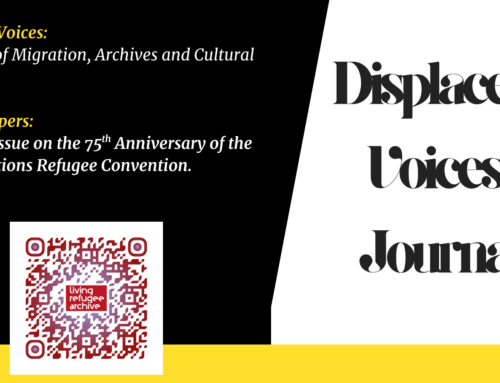
Launch and Publication of Displaced Voices: Volume 1 Issue 2 (Winter 2021). Special Issue: In Their Own Voices: Making Visible Lives of Refugee Women In Kuala Lumpur.
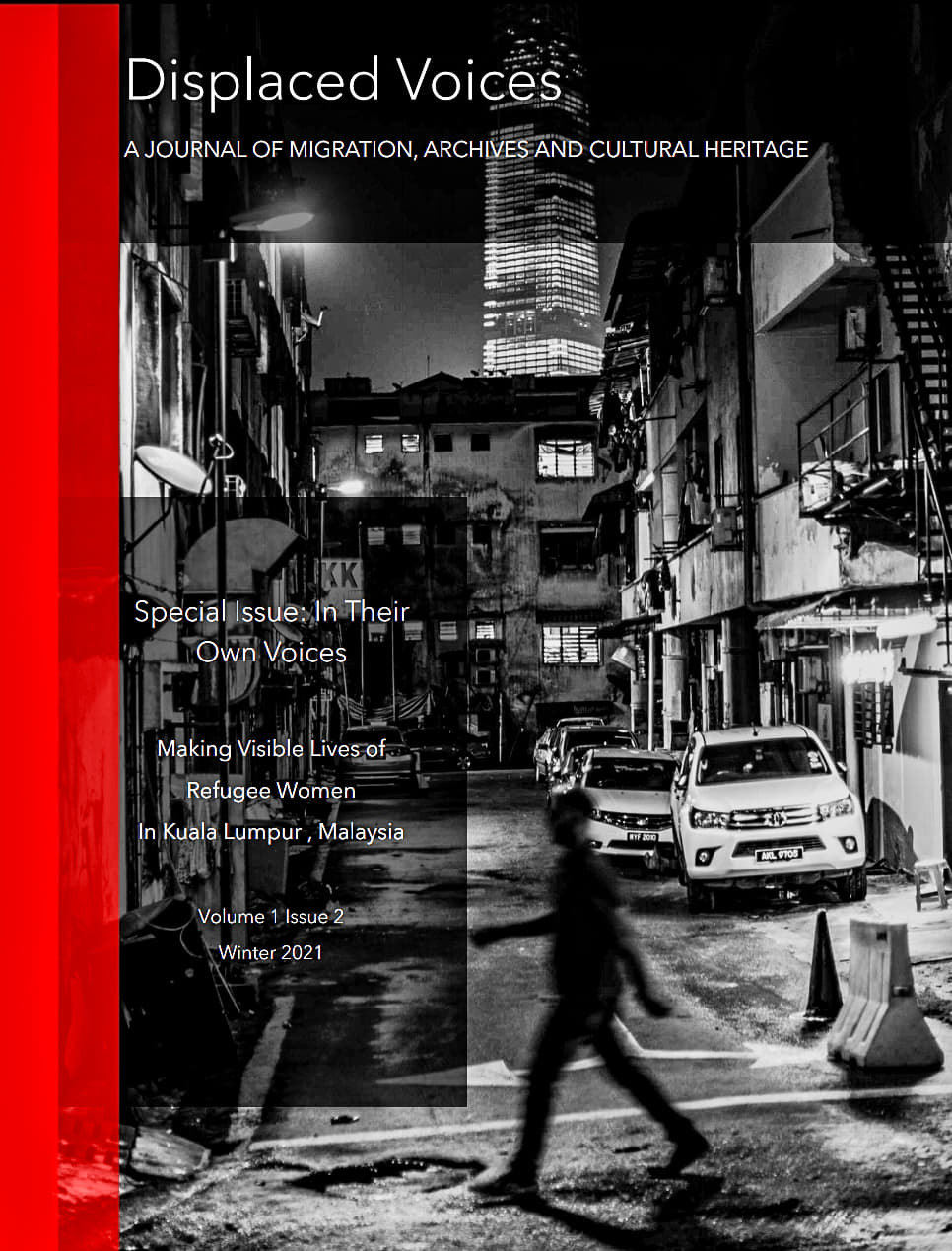
We are pleased to announce the launch today of the second issue of our open access journal Displaced Voices: A Journal of Migration, Archives and Cultural Heritage here on the Living Refugee Archive. Displaced Voices, Volume 1 Issue 2 (Winter 2021) is a Special Issue of the journal entitled, In Their Own Voices: Making Visible Lives of Refugee Women In Kuala Lumpur
Working in collaboration with Kiran Kaur, Amin Kamrani and contributors, this special issue is a collection of papers written by and with refugee women based in Kuala Lumpur, Malaysia, with a foreword from Professor Nergis Canefe based at the Refugee Studies Center at York University, Canada. Our final contribution is visual rather than written and aims to highlight the spaces, actions and voices of refugee communities without emphasizing a victimhood narrative or imagery. All contributors to this project were participants in a doctoral participatory action research (PAR) project in Kuala Lumpur, Malaysia. In this issue we explore what inclusive publishing might look like and rather than speak for refugee communities, we can instead speak together.
This issue of Displaced Voices (ISSN: 2633-2396) can be read in conjunction with Amin Kamrani’s 20/20 Virtual Exhibition of photographs taken during the 2020 pandemic and available via the Living Refugee Archive on the dedicated 20/20 Exhibition Gallery page. Photographs from the 20/20 Exhibition are available for purchase online with 60% percent of the proceeds from every sale going directly to refugee communities in need within Kuala Lumpur. To purchase a limited edition signed and number photograph, visit our dedicated website at: https://www.livingrefugeearchive.org/shop/
“I’m really proud of this … publication where I have been co-writing with a group of refugee women who are also community leaders and activists. We also have a beautiful gallery exhibited in the issue which looks at how we can undo the victimhood narratives and images we often see portrayed in the media.” Kiran Kaur.
This publication highlights the importance of participatory approaches to wo working with displaced communities and looking to challenge and undo the reliance on narratives of victimhood by encouraging empowerment by enabling a space where genuine narratives can be presented. Our work both with the Living Refugee Archive and the physical archival collections that we hold at the University of East London are reflective of this commitment to empowered participation and bottom-up archive and oral history methodologies for helping to support and document experiences of displacement.
How we approach the archiving, and be default the representation, of narratives of displacement underly how these narratives will be represented within the historical record for posterity. The archive by default wields considerable power over memory and identity, they represent active sites of contestation where societal notions of representation and belonging are either accepted into, or rejected from, the archive. Archives and archivists retain the power as gatekeepers to this collective memory, to determine what is accepted and how this is represented back to society as a whole. The importance of the narrative work included in this issue of Displaced Voices is to challenge the under-representation of displaced voices within the Archive and as Canefe argues in the Forward to this issue, to challenge to established media reporting on refugee experiences where both the refugee and their narrative are considered disposable, and to reconsider traditional approaches to archival work, and to challenge existing “canonized forms of archiving, collecting testimonies and keeping a tally on human suffering.” (Canefe).
We hope you will find this edition of Displaced Voices is of interest, and please do let us know your thoughts and comments on the content of this journal. You can contact the editor, Paul Dudman, on displacedvoices@livingrefugeearchive.org with you comments and we may include some of these on the website.