Guest Post:
Harnessing the Power of Collaboration in Refugee Studies: The Example of Displaced Voices II
By Akinpelu Funmilayo
PhD Researcher at the University of Alabama
Motion for Collaborative Expressivity
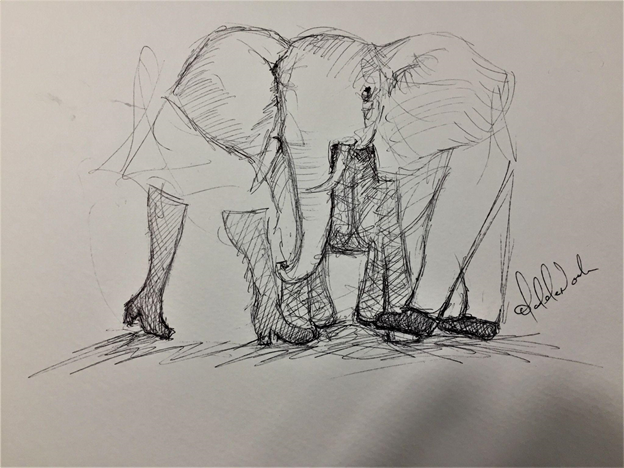
Big Feet, Big Al, drawn by my friend and housemate, Noah Oladele.
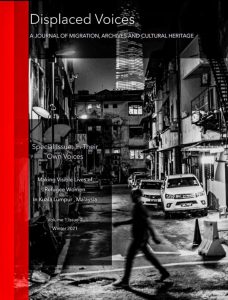
Displaced Voices:
Special Issue: In Their Own Voices Making Visible Lives of Refugee Women In Kuala Lumpur
If there is anything that I have come to learn recently, it is that things are not always what they seem to be. Perception is as relative and individually grasped as people’s taste in music and the subjectivity of perception becomes even more clear and banal when our eyes collide with blurry metaphors that are mobile, non-sentient, and dynamically orbiting several spatial territories. It is why such topical issues as fragile and fluid as migration, refugeeism, and disrupted mobility pose as complex dialectics that are perceived and construed differently and do not give room for a commonly shared understanding. For this reason, the narrativisation of migrant and refugee issues have always been met with discordant contentions, contestations, and conflicted ideologies. Even more, academics who weigh in on the (hi)stories and trajectories of several cases of refugees or those who are still asylum seekers, as well as the woes of third-country nationals seeking, by all means, to travel or stay in countries beyond their native nations have been considered to be armchair critics with all mouth and no trousers. This underscores the importance of borrowing the lenses of directly affected people when speaking on such issues as refugitude. Kirandeep Kaur and her colleague for Displaced Voices II understand this clearly and this explains why they took a highly collaborative approach towards the discussion of people who have, due to circumstances, sought refuge in Kuala Lumpur, Malaysia. Represented in the journal are Somalis, Afghans, and the people of Rohingya. Realising that the perspective of refugees and migrants have been wiped out just as much as their faces have been eroded from discourses made Kaur’s presentation of a scholarly endeavour as a continuum of storytelling ventures that do not just “keep a tally on human suffering” but also gives the concerned humans to chart their experiences using scholarly means quite much needed and welcoming.
Just as was stated in the foreword written by Nergis Canefe, “the project is [indeed] a testimony to the fact that using collaborative and inclusive methods of fieldwork in the form of a genuine human dialogue and materializing the transformative potential of willful action is indeed possible”. Canefe’s emphasis on the difficulty of connecting with the stories of people whose stories do not concern our lifeworld’s begs two questions. We are confronted with the possibility of empathising with the struggles of people whose lives count as mirror images reflected from one end of the spatial spectrum to another. For one, connecting with Afghan, Syrian, Mexican, Rohingyan, Nigerian, or Malaysian… refugees whose lives have been rendered chaotic by the harried attempt to find a belonging outside of their situated habitations stunts our perception of what their realities are.
However, another related question has to do with whether collaborative or inclusive writing which pulls in some of the narratives from members of refugee communities truly guarantee adequate, extensive, and encompassing perspectives; this question arises from recent discourses about the politics of representation and which truly makes the notion of collaboration and inclusivity quite complex and dynamic. In collaborative endeavours or community narrativisations, who should be included, whose voice should be heard and how should the included voices be conveyed and transmitted? These thought-provoking questions were asked in more ways than one and there are really quite a lot of reservations that come as excess baggage when these questions are put into perspective but if there is anything that becomes clear from the polemical writings of scholars who contributed to the second issue of the Displaced Voices journal, it is that the actuality and viscerality of refugee and migrant experiences make it almost non-containable within the constricting medium of words. Having a consciousness about this makes one come to grips with the importance of documenting first-hand narratives and attributing name-ness and non-anonymity to the rhetoric of creating alter-politicised canons for the storied universes of refugitude and migrantship.
Modes of collaborative expressions

Perceptions, house collage ‘filtered’ from Kamrani’s portrait
The contributors to the second issue of Displaced Voices did not just muse over the need for collaboratively and first-handedly telling the stories of refugeeism, they also proactively took the first step in displaying how their proposed motion for collaborative expressivity works. This was done through the incorporation of first-hand narratives from four refugee women – Naima Ismail, Sharifah Shakirah who translates for Syedah Husain, Parisa Ally and Arifa Sultana.” On the first perception, it might look like the individuality of these women and the singularity that is perceptively assumed to shroud their narratives will affect the authenticity or collective representation of the brand of refugitude that they are portraying but this perception largely stems out of the general stereotype of collective experientiality that pervade discourses about refugeeism and migration. Like every other vicissitude of life, the experience of being a refugee or travelling as a migrant is very personal and particular. It does not matter that one is camped in the same camp as other people seeking asylum, it does not matter what one went through. Being a blurry, oblique metaphor seeking permanence and visibility is a shitty business, each round of trial has its own peculiar odour and grossness that slips out from one’s own body like a badly spoken slur. Besides, like Canefe pointed out, “the focus is not on the specific stories of individuals alone. These are instances of circumscribed storytelling that aim to challenge the assumptions, lacunae and areas of tension in our record of the present time, and they compel us to develop a more critical approach to the image of the refugee, the asylum seeker, the illegal migrant”. Another popular stereotype is that refugees need to have their stories told on their behalf because they just cannot do it for themselves; they are way too ill.
The idea is that they are running, searching, skimming, dreaming, and hardly even living, so, how can a soul that is not alive have the time or waste effort on being a sophist or educated enough to. Oh yes, they may know the place of their beginnings, identify with it, grow into it, but it would take a labouring task to assimilate them into the dream of such existence that they have come to own for themselves. Hence, while they may successfully be able to speak their native language, English, French, or whatever European language has come to be their second tongue would never come fully natural to them. This fallacious stereotype has caused discourses about refugeeism to be collocated with oral history, oral literature, folklore, traditional everything, indigenous culture this and indigenous culture that. But to be placeless is not to be brainless and this is what the Kuala Lumpurese women who shared their stories via Displaced Voices demonstrated. But beyond the fact that the women could very well articulate their experiences as refugees, a more pertinent question arises: does writing and communicating in English poignantly and accurately embody the experiences of non-English refugees?
Arifa Sultana, one of the contributors, had expressed the difficulty of putting “her journey into words” not only because of how the rigours of editing sift away the evocative quality and vehemence of her voice but also because linguistic words could do little to convey her subjecthood which has a panoramic texture to it that goes beyond her identity as a refugee and extends to the vista of “her hope for a better life and her desire to be more than this limited (and violent) response to her identity”. It is interesting to see how she manages to compress details about her life in a few pages, yet showing how much more there is to her life than being a journalist in Kuala Lumpur that focuses on issues that affect Rohingya. Her insightful knowledge into how local self-representation creates room for a more conscientious reportage of refugee communities like the Rohingyas; it is with this argument that Sultana defends the alienation that often trails international media and legal coverage of refugee stories. For Sultana, the eye-rolling blunders that come from internationalist-bent news on refugeeism is a product of how “refugee communities do not get the opportunity to decide for themselves how they can be understood or seen and it is always someone else deciding for them how they will be represented or even what they need”. Naima Ismail’s work and passion for health inequalities/equity activism, her translation skills and her own personal experience as a refugee in Malaysia distinguish her as one who would want to leverage language as a mode of communication. This is reflected in her desire to obtain a Master’s degree and actively dedicate herself to the association she formed in 2018 – Somali Women’s Association Malaysia (SWAM). Regardless, Ismail is well aware of how overdependence on words can rob people of access to basic needs; the fact that one of the reasons Somali women cannot access good health services is their inability to communicate with doctors has driven her to ‘cherish’ her knowledge of English language but it has also left her disillusioned. Ismail also expressed her exasperation about NGOs who shove their ideals down the throats of refugee members (both linguistic, ethical, and cultural) with little regard for their privacy, silence, and autonomy.
Parisa Ally’s knack for combining critical thinking with storytelling yielded dynamic rhetoric that reflects in the paper she co-wrote with Kaur, an article that seemed to bottle up a lot of pent-up anger, sadness, and conscious knowing about pain, vulnerability, and violence. By telling the stories of three women – Zohra, Nargis, and Shamila – Ally taps into the power of writing and uses it as a vent hood to show the precarious situations of harassment, unemployment, sexual predator-ship, political cum religious conundrums, gender-sexual discriminations, domestic violence, migratory trauma, and sheer listlessness that Afghan women living in Malaysia with or without their partners go through. Ally, however, admits that there is something more important than writing; it is the application of critical thinking to the process of creating change and this can be done not just through formal education but through the Syedah Husain, under the prompting of Sharifah Shakirah speaks to situations that have always gripped my own heart with helpless agony and concern – the bane of child marriage, forceful marital contracts, female sexual ignorance, and repro-centrism.
While the narratives projected by the four refugee women were powerful in their own rights, one cannot ignore the viscerality and vividness of the photographs captured by Amin Kamrani. However, just as Kamrani noted, the photographic elements of the frame, light, and angle distort portrayed realities and give them differently configured outlooks. However, even realities seen with the eyes are also curated and constrained by our perceptions; so the question of whether we can truly ‘see into’ the experiences of refugees, much more, fully express them is still on the table. Regardless, the imaginative lucidity which Kamrani affords viewers makes one think about whether non-textual modes of expression – photography, painting, podcasts, and experimental artistry – better represent the experiences of refugees. Kamrani’s decision to project portraits and faces of people that look nothing like the darkness and grimness that are associated with refugeeism is a deliberate, much-needed depiction of the non-binaried complexity that shrouds the lives and experiences of refugees; in using the portraiture mode, Kamrani leverages the fact that the human face is a panopticon of paradoxes that is open to public viewing but can be tempered in ways that make us see what we only choose to see. Due to the relative substantiality and tangibility of visual, auditory, and other sensorial works, one can argue that they present themselves as the best modes to document and represent the works of refugitude in inclusive ways that ensure profound visibility. It’s even more so because embodying self-representation literally means letting the concerned person go their own route to telling their own stories, be it through texts, spoken words, art, or what Kaur calls ‘photovoice’. Against this backdrop, the necessity of using other possibly available modes of expression to leverage the collaborative prowess of non-human and posthuman entities become clear and indisputable. Relatedly, the dialectic of anonymity becomes less complicated when the idea of self-representation becomes detangled along the lines of freeing self-expressivity. For one, anonymity and non-anonymity are also modes of telling, and to allow one or the other is to subscribe to a choice to or to not tell the face as well as the story.
Motifs for Collaborative Expression
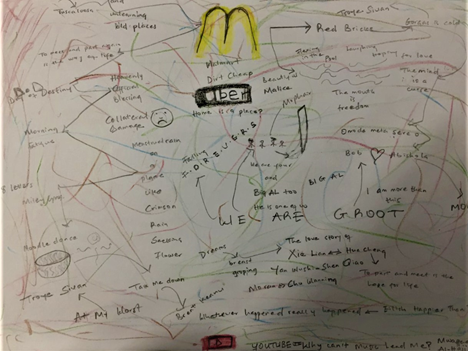
Alabama-Esque, messy scrap scrabble by me.
People who are marginalised and oppressed (and traumatized) need the ability to critically understand the systems they live in to be able to create change that is positive for their own lives and communities – Kirandeep Kaur.
What stories should refugees tell about themselves? Just like Arifa Sultana talked about, what constitutes voguish discourses about refugeeism and migration is the emphatic elucidation on human rights applicability and accessibility, as if the humanity of asylum seekers, refugees, and migrants (legal or illegal) should be questioned in the first place. The solemnity and sombreness with which issues surrounding the denied rights and freedom of refugees and migrants are discussed often overshadow the absurd fact that ‘human rights’ are in themselves socio-political constructs that have, over the years, become a justification for the ‘dehumanisation’ of certain sections of the society whilst reifying the gratification of people and places who ‘graciously permit’ the ‘re-humanisation’ of people who were always and will always be human regardless of their status, identity, or nationality. For mainstream media outlets, there is a naive and sometimes inadvertent commodification of pain and grief. However, just as Sultana said in her article, ‘persecution’ is the refugee’s mantra and the possibility of migrating as a refugee to seek out betterness is an ideal that goes against this established mantra. Much like the situation in Myanmar where the people of Rohingya are being treated violently and even expelled, it nearly becomes impossible to see beyond the maltreatment of these people by a state entity and focus on their personhood. For this reason, there will never be an end to talks about anti-human rights, anti-asylum propaganda or fancy appellations that label the victimage of refugees and political policy justifications for ‘hosting’ them in ‘free’ countries. Due to this narrow-mindedness of telling refugee stories, the past and probable future of refugee communities is completely eroded and or, at least, made subject to erasure. Despite the staunch, seemingly unmovable angles from which refugee stories are told, Kamrani has urged that there should be a strong awareness about who is telling a story be it a writer, a photographer, a journalist, or a policy advisor/maker and whatever story is told should be followed by actions, actions that stem from open-mindedness, trust, and genuine ventures to open up avenues through which the owners of the stories, the refugees themselves, can tell their stories.
You see, what should be said is not what is hypothetically supposed to be said, but what the storyteller wishes to say and express. This could range from depressing, sensitive topics about the very identity construct of being a guest in a foreign land to happy, silly, dreamy, secular and mundane topics like how refugees cope with the need for companionship, company, and comfort in a place where they supposedly feel alienated. In the case of Rohingya people, Sultana did say that “the useful manner to represent the Rohingya stories would be better if the Rohingya themselves are asked about how they want to be represented and how they see themselves in real life… I just want to be seen as human” not something special and nor degraded as refugees… (or as) a ‘burden’” It is within this discursive terrain that divergent gender, cultural, and sexual orientations can be unfurled and demystified. To say that a person can both seek/want/need refuge in a foreign land and be queer/non-queer and educated/non-educated and religious/irreligious and happy/sad and yet concerned/cynical/indifferent about the terribleness of not being back home, free and non-harassed, should not be strange. To say that people who escape the violence and persecution of their homelands want shelter, want their rights asserted, want education, want love, want sex without the stigma that comes with wanting it, want to practice religion without feeling choked by its overseeing institutions, want empowerment without NGO-tistic snides, want happiness, want jobs, want freedom, want good marital partners that do not vent out migratory frustrations on them, want a home both in where they are now local and where they originally come from.
Parisa Ally spoke of how she uses the medium of writing and storytelling as therapeutic means to heal from trauma and transcend the realm of naive consciousness in which one believes that humans cannot escape the hands of fate or ill-fate into the realm of critical consciousness where one is aware of the oppressive systems that inflict suffering on humans whilst giving one’s own self the permission to share stories that critically air out conditions of oppressions (Kaur had mentioned this in her conversation with Ally about the Brazilian educator Paulo Freire). In order for stories that bespoke such level of critical consciousness to be told, refugees need to be allowed to say what concerns their lifeworld at particular points in time; it is in the simplicity of their stories, it is in their unabashed statements about seemingly mundane pleasures and hardships of life that the authenticity of their struggles can be truly felt.
Sometimes, like Sharifah Shakirah, founder of Rohingya Women’s Development Network (RWDN) who allowed Syedah Husain’s personal, traumatic story to be told on Displaced Voices II, the stories told by refugees are not personal, they might convey someone else’s realities but they contain shards and pieces of truths that rim the existences of the refugees who tell them; this is because stories are broken mirrors splattered across space; to pick up a piece is to have something to remember and see and feel, like footprints, like memories, like dreams… As it is, the need to let the refugees speak for themselves is just as great as the need to connect with their stories without having them go through the exaggerated embellishment of scholasticism that often shrouds the retellings of refugee and migrant experiences. Because just as was said by Kirandeep Kaur, “if we cannot connect with their stories, can we truly understand them?” It is in the spirit of fostering understanding through collaboration and individualistic storytelling that I have written a story about my experience(s) as a migrant who arrived in Alabama, USA, recently and has only been around for a few days. Although this is my story, it offers an abiding perspective on the thought processes of a migrant in a new territory.
LRA Blog Disclaimer
The views expressed on this blog are attributable to their individual authors writing in their personal capacity only, and not to any other author, the editors, or any other person, organization or institution with which the author might be affiliated unless explicitly stated so.