Guest Post:
Refugees and Political Power in Non-Signatory States
by Dr. Sarah Combellick-Bidney
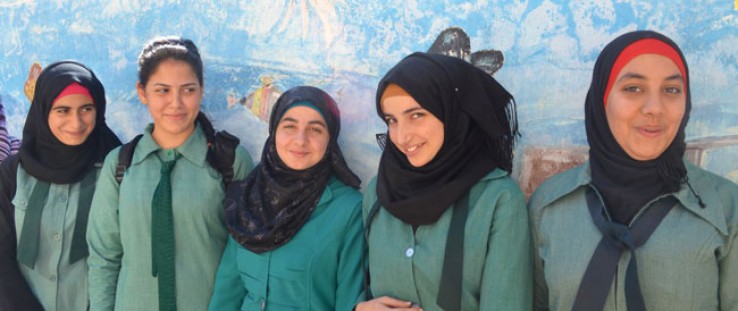
Girls in Jerash pose in front of their school’s storage tank that is painted to look like an aquarium. Photographer: Alysia Muller.
Reproduced in: `Water from a Stone: Jordanians Stretch Meager Resources to Sustain Syrian Refugees’ by Kathy Sullivan at www.usaid.gov/news-information/frontlines/water-neglected-tropical-diseases/water-stone-jordanians-stretch-meager
Refugees bring to bear significant political power around the world, including in repressive environments where their rights are not protected. After leaving their countries of origin in order to escape life-threatening violence, they must determine how to navigate complex and often hostile political landscapes and in order to find a place to rebuild their lives. Throughout this process, they wield political power to change the environments around them.
Coverage of refugee issues disproportionately focuses on moments of hardship, and has yet to fully show the dynamic force of refugee political power in the places where they live.
The examples here are deliberately chosen from areas where refugees are assumed to have very little power. They each took place in countries which have not signed the 1951 Refugee Convention and its subsequent 1967 Protocol.
Jordanians demand open borders for Syrian refugees
Coverage of Syrian refugees in Jordan may focus on current tensions over water scarcity, but a crucial fact is that Jordanians made history by welcoming Syrians precisely because of their own experiences with forced displacement.
Most Jordanians are no stranger to the refugee experience. Jordan is a Middle Eastern country that occupies a niche as a home for refugees from the occupied territories of neighboring Palestine since they were pushed out or fled that region in the Nakbah, or the events surrounding the establishment of the state of Israel in 1948. Much of the Jordanian public feels a connection to the trauma of surviving the Nakbah and seeking asylum, either through personal experience or family history. Jordan has recently has hosted many other peoples fleeing persecution. However, it has not signed the Refugee Convention of 1951 or its 1967 protocol, and significant issues remain in its refugee policies and practices.
Water scarcity in particular has been a flashpoint for relations between Jordanians and the Syrian refugees in Jordan. In recent years, the pressure on the already sensitive watershed has increased, with the groundwater being depleted more quickly than it can be replenished. Jordan is now considered one of the most water-scarce states in the world. But the creativity in accommodating new visitors has also been groundbreaking, as USAID showed in their report “Water From a Stone: Jordanians Stretch Meager Resources to Sustain Syrian Refugees.”
However, the remarkable fact that distinguishes Jordan from so many of its peers in the region is this: even when Jordan’s resources are stretched thin due to the influx of refugees, Jordanians did not demand more restrictions at the border to stop the flow of refugees; they did the opposite. The Jordanian public demanded open borders during the civil war in Syria in a campaign called “Open the Borders” and became a trending topic on social media in Jordan. The participants were diverse and included human rights organizations and activists in many countries, but Jordanians themselves formed the epicenter of the campaign.
The campaign to open the borders marks Jordan as a polity deeply shaped by refugee experiences. However, it is notable that even as it has the highest ratio of refugees to citizens among all the countries of the world, it has not signed the 1951 Refugee Convention nor its 1967 Protocol. The state itself is not a guarantor of rights for migrants of any kind, and has an archaic way of referring to them. “In practice, Jordan avoids the official recognition of refugees under its domestic laws and prefers to refer to Syrian refugees as ‘visitors’, ‘irregular guests’, ‘Arab brothers’ or simply ‘guests’, which has no legal meaning under domestic laws” (International Labor Organization, 2012). Most tellingly, Jordan’s government closed the border to Syrians during the war, and required significant public pressure to open them.
What would be considered normal state behavior was transformed by public pressure. These facts highlight the crucial role played by Jordanian refugees, their descendents, and their allies in protecting those who had to flee Syria during the war.
Qatar: Refugee rights and workers’ rights are intertwined
Qatar is an oil-rich Gulf state that has historically avoided receiving and protecting refugees. Refugees are not differentiated in any clear way from other migrants when they cross the border. In 2017-2018, however, the situation for refugees in Qatar improved thanks to collaborative efforts to increase justice for all migrant workers. While it may seem on the surface that the National Asylum Law itself led to these improvements, it was also a significant labor and human rights crisis that a coalition formed to change FIFA policy and enforcement via Qatar’s bid for the World Cup. This victory raised the bar not only for the Qatari government, but for FIFA and corporate sponsors as well.
The creation of the National Asylum Law was a sea change in Qatar’s refugee policy on the national level that was possible when allies of Saudi Arabia imposed a blockade on Qatar in the course of the Gulf Diplomatic Crisis of 2017 (Kim, 2019). This was the second time they had demanded allegiance from Qatar (the first was in 2014), which they saw as a rogue state undermining their policy consensus on how to promote stability in the region. But this time, Qatar was more resistant to the demands. It decided to stake out a clear position of its own in opposition to Saudi Arabia. The National Asylum law, besides being a humanitarian necessity, was a way to protect dissidents who were not welcome in Saudi-allied countries, strengthening Qatar’s position as an intellectual and humanitarian leader in the region.
Updating laws to grant official status to more refugees is a significant step for any country, and the importance of Qatar’s policy shift should not be understated. However, even before the blockade was imposed and the National Asylum Law on the books, an equally significant shift was already underway in the realm of labor rights. The climate for most refugees and migrant workers in the country needed to be addressed, due to the exploitative labor practices of the preparation for the FIFA World Cup that were happening right under the nose of the Qatari government.
News sources revealed that at least 6,500 migrants died in the construction industry working on building for the World Cup in 2022. The causes of these deaths were varied, but tied to poor labor practices (dehydration in the hot sun, for example, when employers required workers to pay for water). Families of workers who had died began a campaign to change these practices, working together with concerned citizens around the world.
The Al-Ghufran tribe within Qatar had interests that coincided with those of migrant workers on this issue. The tribe submitted a complaint to FIFA and petitioned the UNHCR to stop the construction because it amounted to an unlawful taking of their land, and a stripping of citizenship rights of Qataris who occupied the region. These actions, together with the widespread lobbying of FIFA to stop the labor abuses, resulted in the following victories: the abolition of the abusive “kafala” sponsorship policy, a new minimum wage for workers, eradication of the exit permit rule, and collective bargaining for workers, i.e. protection of the right of workers to form a union (Kim, 2019, p. 177).
Since these changes, Qatar has focused on building its image as a refugee protector. In 2020, Qatar claimed its donations to the UNHCR had reached the $24 million mark, making it the largest donor among Arab countries, and the 20th largest donor in the world. Ultimately, the policy changes refugees fought for amount to a significant shift that improved Qatar’s standing on refugee issues among Gulf states.
Rahaf Mohammed: Targeted disclosure to open doors
This final story of refugee political power is the most direct and individualised of all the examples here. It is the story of a Saudi woman leaving her country of origin and using strategic disclosure on social media in Thailand to stay safe and gain asylum in Canada.
Rahaf Mohammed is a young Saudi woman whose actions brought the world’s attention to the dangers women face in Saudi Arabia. She had decided to leave Islam, which is allowable along with other personal freedoms in Islam generally, but is treated as a capital crime in Saudi Arabia. In response, her family had abused and threatened to kill her, and planned for an arranged marriage. In January 2019, when she was 18 years old, she was with her family on vacation in Kuwait when she found a way to escape. She caught a flight to Bangkok, where she got a hotel room in the airport hotel, locked herself in the room, and barricaded the door. She began to post about her situation on Twitter. “I’m afraid. My family will kill me.” She had 24 followers on Twitter at the time.
Her friends shared the tweet with the hashtag #SaveRahaf, and soon more people heard about her plight. In the time her story was making its way around the world, subtle political changes were taking place. In Saudi Arabia, her family disowned her and the government began a smear campaign that she had been influenced by outside agitators. It also faced greater pressure to uphold women’s rights. In Thailand, the police officer overseeing her case announced, “We will not send anyone to die. We will not do that. We will adhere to human rights under the rule of law.” She was delivered to the UNHCR, which began arranging for her asylum “on a fast-track emergency basis” (UNCR statement, 2019). She had intended to go to Australia, but Canada was proactive in welcoming her. She arrived in Toronto on January 11th, 2019.
The Saudi government has repeated their concern that Mohammed’s actions would lead to a scourge of girls and women leaving their families and making asylum claims. And indeed, Mohammed said she hoped her story would empower other women in Saudi Arabia to be “brave and free.”
Stories matter
Stories of refugee power are crucial because, as one researcher says, “[a purely] humanitarian approach renders refugees voiceless and suggests an image of refugees as victims who cannot survive without help from the outside world – with adverse implications for refugees” (Lee, p. 265)
The victim narrative could not be farther from the truth; as long as states enforce borders as a means to control human migration, refugees themselves will be the drivers of change.
Author Bio
Sarah Combellick-Bidney is an associate professor of political science at Augsburg University in Minneapolis, Minnesota.
Works Cited
KUTTAB, D. (2018) ‘”Open the Borders” Campaign Puts Pressure on Jordanian Government to Accept Syrian Refugees’. Arab News. Available at https://www.arabnews.com/node/1330376/middle-east <Last accessed April 15, 2021>
KIM, J. (2019) ‘At the Border of Human Rights: Analyzing State Compliance with International Refugee Protection Norms.’ Dissertation, University of Nebraska.
International Labour Organization, Arab Regional Offices. (2015) ‘Access to work for Syrian refugees in Jordan: A discussion paper on labour and refugee laws and policies.’ Available at https://www.ilo.org/wcmsp5/groups/public/—arabstates/—ro-beirut/documents/publication/wcms_357950.pdf <Last accessed April 15, 2021>
LEE, S. (2012) ‘Scattered but Connected: Karen Refugees’ Networking in and beyond the Thailand-Burma Borderland.’ Asian and Pacific Migration Journal, Vol. 21, No.2.
‘UNHCR statement on Canada’s resettlement of Saudi national Rahaf Al-Qunun.’ (2019) UNHCR, 11 January 2019. Available at https://www.unhcr.org/news/latest/2019/1/5c38e9134/unhcr-statement-canadas-resettlement-saudi-national-rahaf-al-qunun.html <Last accessed April 15, 2021>.
‘”Nothing to lose”: Saudi teen Rahaf Mohammed details family abuse.’ Al Jazeera 15 January 2019. Available at https://www.aljazeera.com/news/2019/1/15/nothing-to-lose-saudi-teen-rahaf-mohammed-details-family-abuse
<Last accessed April 15, 2021>